


I’ve been marveling at the architecture of Hogwarts Legacy again. It’s almost unfathomable to me how anyone could design such a massive, sprawling place and have it absolutely loaded with interesting little nooks and crannies.
In particular, the use of balconies and other changes in elevation are hard to visualize, much less invent. Apparently, they took inspiration from many different places: the library from one, the great hall from another, the towers from a third, and so on.
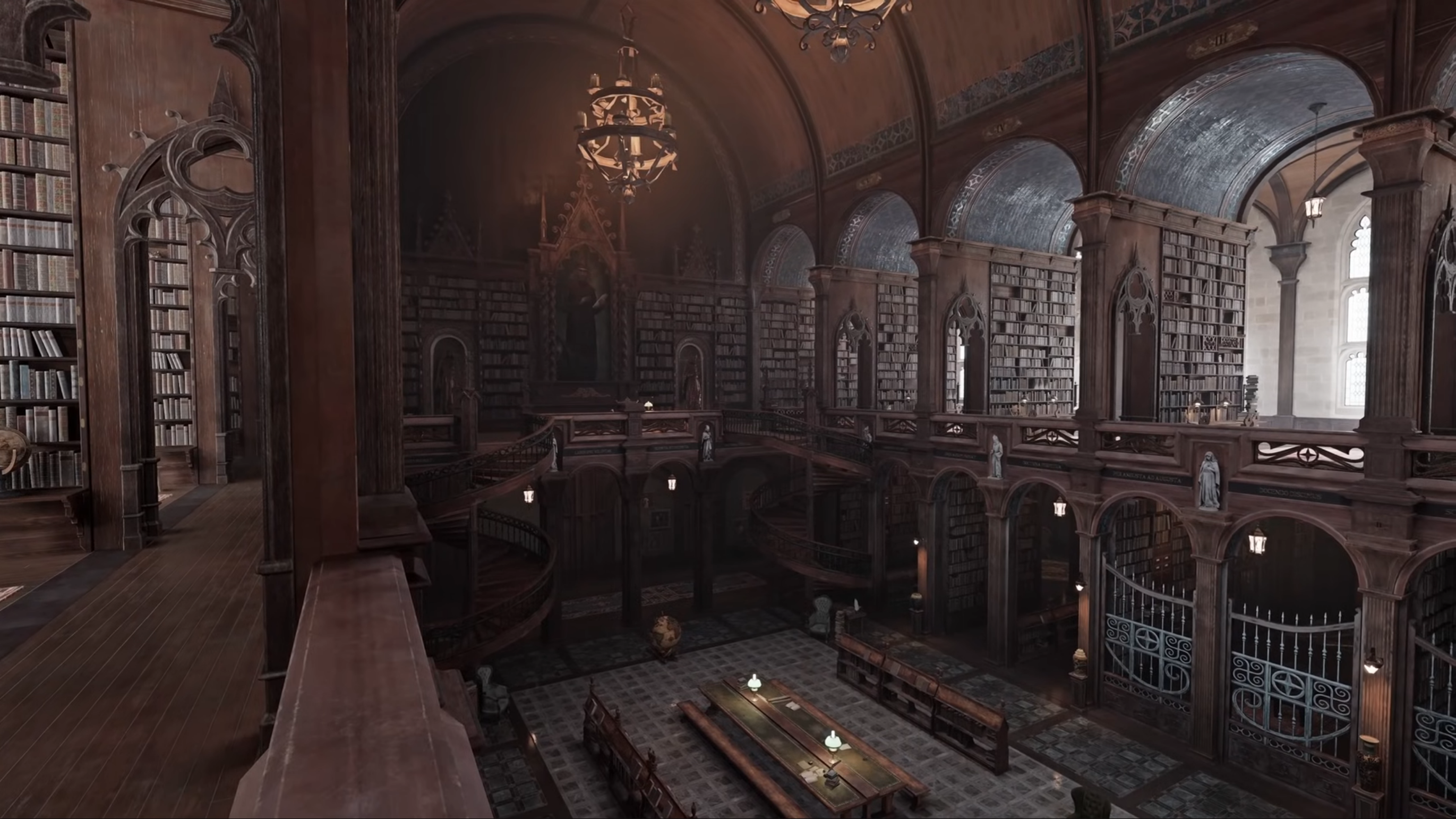
You can benefit from their research by using their game as inspiration for your own locations. Hogwarts is, after all, a castle, a school, a library, a dungeon, and more, and the game even features a nearby town and other locations. Be inspired by the scale of the spaces as well as the clever nooks and crannies and how those nooks and crannies are decorated with fantastical toys.
Another place to look for inspiration is the various palaces and cathedrals in Assassin’s Creed Unity and the ancient cities and palaces of Assassins Creed Odyssey.
But how do you go about designing such things of your own? A grand castle, a great temple, a magnificent monastery? One key technique will enable this.
Outside In
Don’t design the outside. Start with the inside.
So often in fantasy map-making, we begin with a rectangular sheet of paper with a rectangular grid and begin drawing rectangles on it such that a suitable number of rectangles fit. Forget all that. Start with a blank sheet of oversized paper and begin drawing the largest rooms you want in the complex, typically a great hall or vast cavern around which other things will be added to support its function.
Did they do animal sacrifices here? There should be animal pens, a washing room, a preparation room, a butchering room, and so on. Most large chambers have antechambers and large hallways outside them to accommodate people coming and going in large numbers and hanging around conversing. Make sure there are these liminal spaces.
Make a list of those things that are needed to support the great chambers and add several more to it that you don’t have immediate use for. Real-world floor plans of large buildings always have a bunch of small rooms that don’t have a clear purpose; if you don’t think of a purpose by the time you’re ready to use your map, make those chambers empty, store rooms, or refuse rooms (but be sure to put a trap or monster in one here and there).
Use a ruler or grid paper to get a rough idea of how big the big chambers should be, but then ignore any concept of a grid and design large chambers at odd angles to one another. Maybe someone wanted one room to catch the morning sun and another room to present its best face to the main approach. Still another room might conform to the rising of the terrain and/or the shape of a natural plateau. Making your drawing a bit random simulates this.
This also helps to simulate the way real buildings are expanded over time, with additional spaces added wherever convenient some distance away and various small chambers and long corridors added to connect them.
You can rough in a grid later that matches the angle of each room. Not like this, tho.
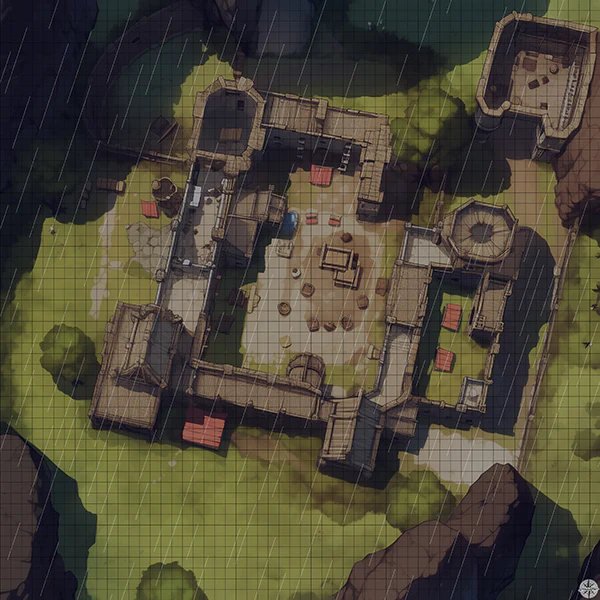
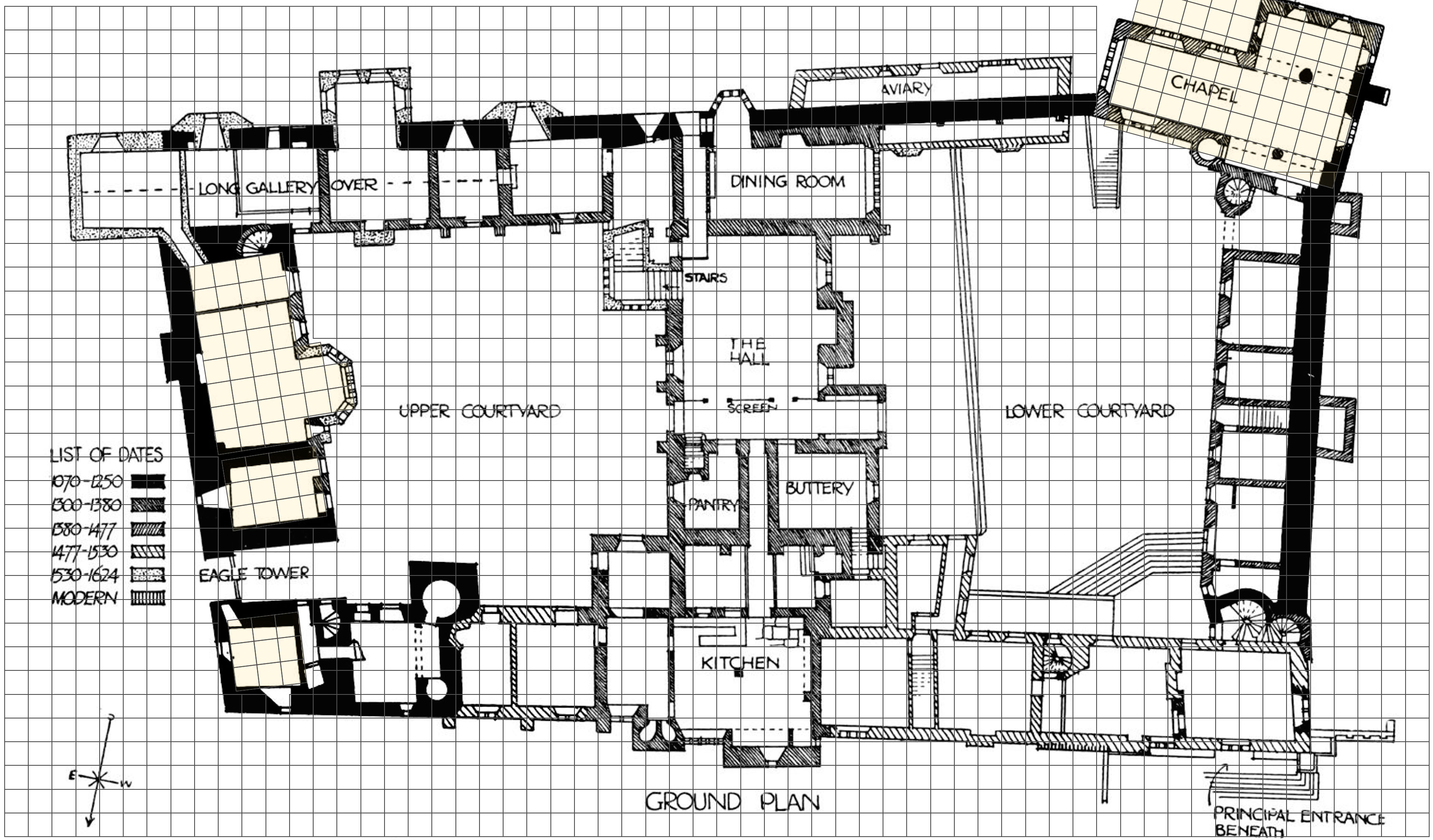
Transitional Spaces Connect Large Chambers
Better still, the randomness of your large chambers will create smaller nooks and crannies naturally as you connect one chamber to another. Add stairs to account for natural variations in elevation and artificial desires for high galleries and balconies overlooking the spaces.
Make the main chambers and shared spaces bigger than they really need to be. Then when you’re adding in other chambers, you’ll find times when you need to squeeze in a narrow staircase, and it will feel natural and interesting.
Designing large spaces will make you realize you need to decorate them with large decor. A giant mural, a huge tapestry, a big statue, a grand staircase, a magnificent fountain…. These things will come to you naturally.
These large spaces should include courtyards open to the sky. This is how people got sunlight into the middle of buildings. It can even work with dungeons underground. Few adventurers learning about the entrance to a dungeon will bother searching the area for other entrances, especially if the other “entrance” isn’t very practical, because it’s a 60-foot sheer drop into a courtyard.
Outside
Once you’ve designed the interior chambers you want, then you can think about wrapping it in a handsome façade. Have some small rooms in front of your big room? Give them lower ceilings, so the big room has upper-story windows. Feel like there out to be a tower on one corner? Add it. Towers don’t really need anything in them but a spiral staircase. They may serve to give access to upper floors, but they may also just allow a view or even be purely decorative.
Most large buildings are surrounded by a number of smaller buildings that supported what goes on in the main building. These include workshops, administrative offices, gatehouses for security, and storehouses for food and little-used furniture and decor.
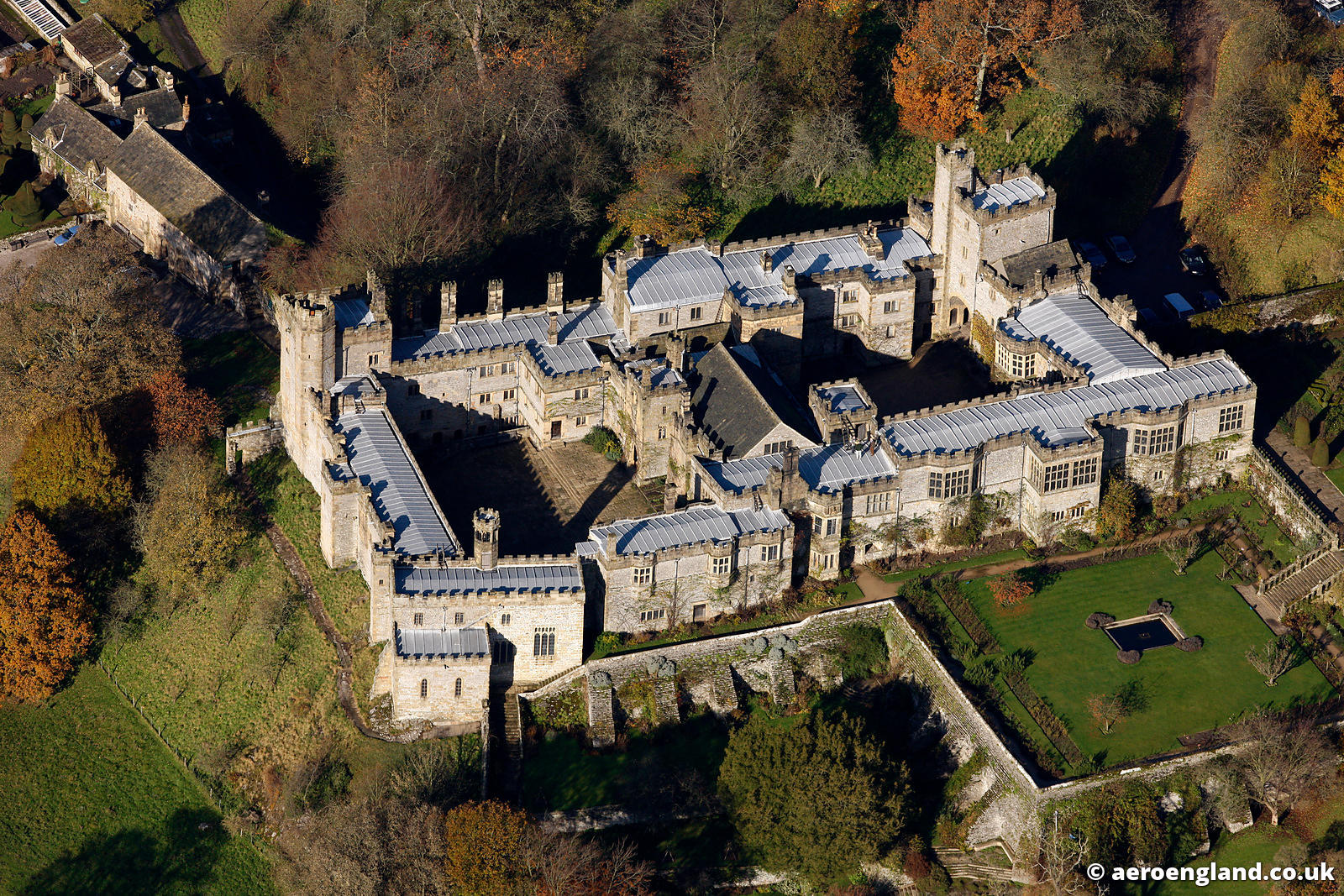
Example
Medieval Haddon Hall, with additions over 500 years.
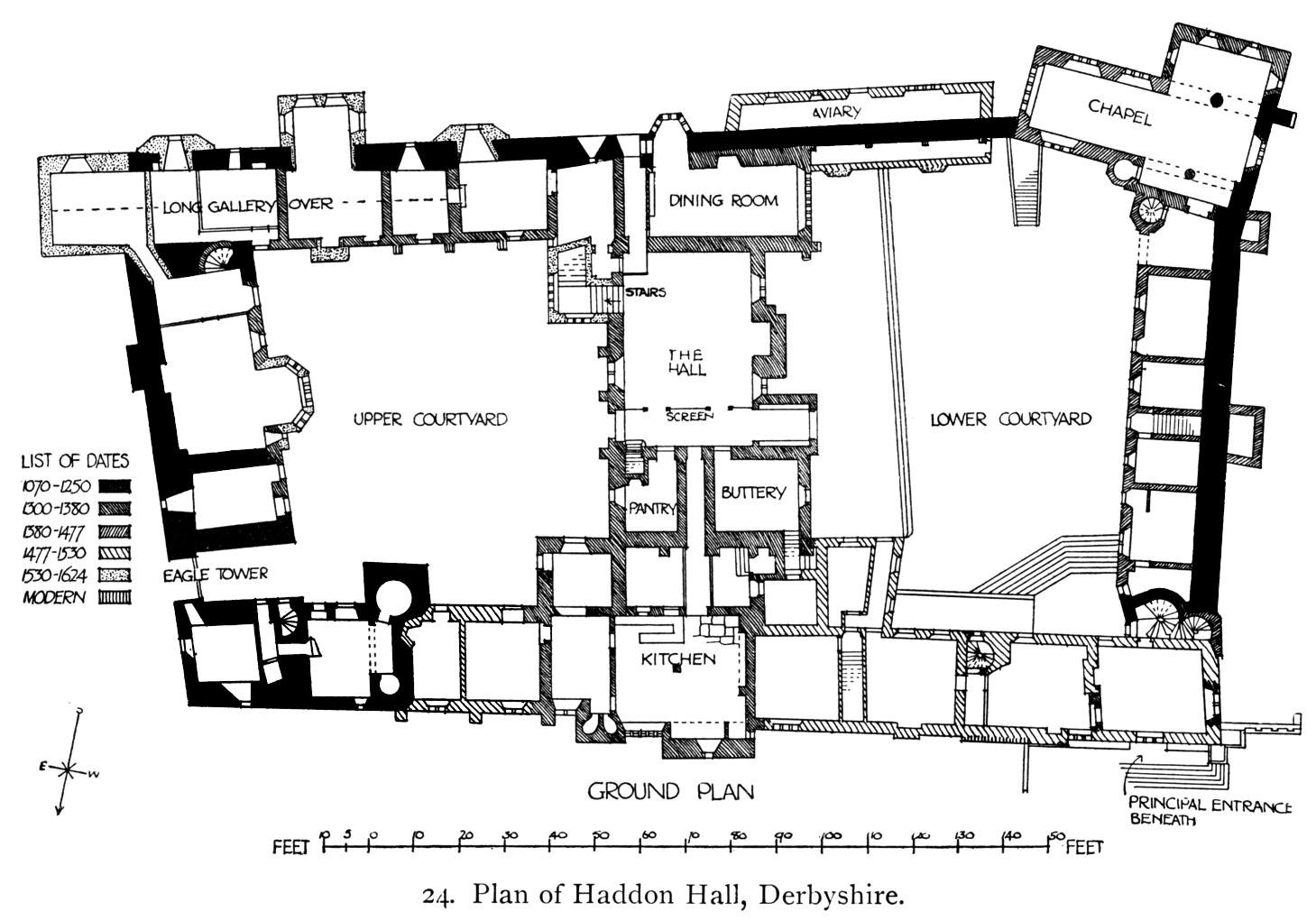
Drawing Your Vision
Unfortunately, I haven’t found a good mapping tool for drawing good-looking floor plans of grand spaces. To be sure, there are many drawing programs, but they all seem to fall short when it comes to enabling changes in elevation.
What’s needed is a tool that supports simple layering and automatically maps stairs, pits, chimneys and such on new layers. (Ideally, layers should be on, off, and see-thru.) If you mark a chimney on the first floor, it needs to be in the same place on the second floor so it can get to the roof. If you plop down the top of some stairs on the first floor, the bottom needs to appear on the first level of a dungeon below.
A good tool would even keep tabs on how deep each area is below ground or how high it is above ground, so that you don’t accidentally create two flights of stairs going up in one part of a building but only one flight going down in another part.
 zarban.com
Leave a comment