

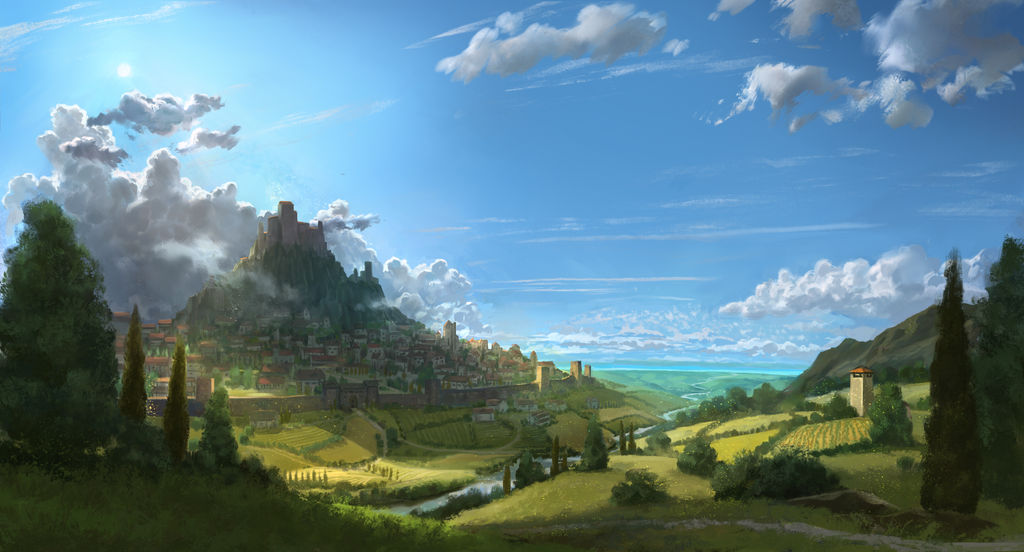
I’ve written previously about how travel should be a significant part of any fantasy RPG campaign, how to create maps with travel in mind, and how to run a travel session. But what if you want the heroes to travel a very long distance? Across the continent to a far-off realm? This is a traditional part of fantasy stories, with the likes of Odysseus and Jason and Sinbad being as famous for their travels as for their heroics.
The Journey of 1000 Miles Starts with 1 Step
For a 1000-mile journey, I suggest you focus on points of interest, both major and minor. Explorers and travelers, both real and fictional, tend to go a little out of their way to stop at interesting places, like a city with a magical fountain or talking statues or a famous soothsayer or ruler. Or a glade with magical plants, or a canyon with stones that whisper secrets. Throw in a random monster specially tailored to the location sometimes: a creature out of Greek mythology for a Greece-like land or one from Egyptian mythology for a desert realm.
A 1000- or 2000-mile journey should be an adventure in and of itself, so 3 or 4 sessions is about right, with each session consisting of events happening at two points of interest on different days.
And if there’s any way at all to tie some of the experiences together, it’s even better. Maybe the heroes get an object or information in one place that helps them in another. Or they meet a great warrior early on and later encounter an army whose leader just happens to be that same warrior. They might even pick up some cargo in one city and sell it for a profit in the next one along the trade route; add drama by creating the possibility that the heroes can escape some scrape more easily if they abandon the cargo (“These sea monsters want the spices!”).
I wouldn’t worry much about the details of timing or terrain. Just figure they move at an average of 2 miles an hour, 8 hours a day. 1000 miles will take them about 63 days. However, safer routes tend to take longer. So you might warn them that going over the mountains, where the Sacred Peak Monastery can take them in, will be slower than going by ship across the Golvanic Bay, where sea monsters lurk. Sailing around the Cape of Fair Weather would take longer than braving the Straits of Many Perils.

As long as the points of interest they visit and encounters they have are tailored to the route, the adventure will feel appropriately customized to the players’ choice, so that choice will clearly be meaningful.
Worlds of Wonder
The nice thing about such travels is that the adventuring can be loaded with wonder and much less with monsters and traps. The heroes’ stay at the Sacred Peak might be quite relaxing, with bathing, a feast, and a musical performance. But it shouldn’t be uneventful. Perhaps the monks introduce them to elderly monks who are in various stages of self-mummification; or the heroes talk with spirits of ancient monks, who have helpful advice. This can relate information that is useful in the following adventure or can be the thing that hooks them into the next adventure.
“No single spirit speaks for long; they sometimes finish each other’s sentences. They talk of an ancient evil and a legendary weapon that can defeat it. That weapon, lost in the bowels of the Corundum Abyss, is the Glaive of Galcunus. The ancient evil, they say, has no name, for none live today who could speak it.”
This is an opportunity for clerics and paladins to visit a holy site, for wizards to visit a library or university, and so on. These sorts of side adventures should gain the heroes experience bonuses.
Rather than try to engage the players in a side quest to solve some problem for the NPCs they’ve just met, you might have the monastery attacked by wyverns or the university suffer a murder that needs to be solved (a simple one–clear evidence points to the culprit). Thrusting the heroes into a conflict suddenly is fun and effective and more likely to trigger their heroic instincts than a ponderous story and negotiation over a reward.
The Destination
Ideally, reaching the heroes’ destination should be an event in itself. Maybe a festival is happening or an emergency is occurring, or maybe there’s a feast in their honor (if they were expected.) The events of the travel should have prepared them in some way for what they need to do next but should definitely not be so momentous that they overshadow the adventure they came all this way to have.
Maybe they gained a modest magic item or learned some key fact about their host or mission.
 zarban.com
Leave a comment