


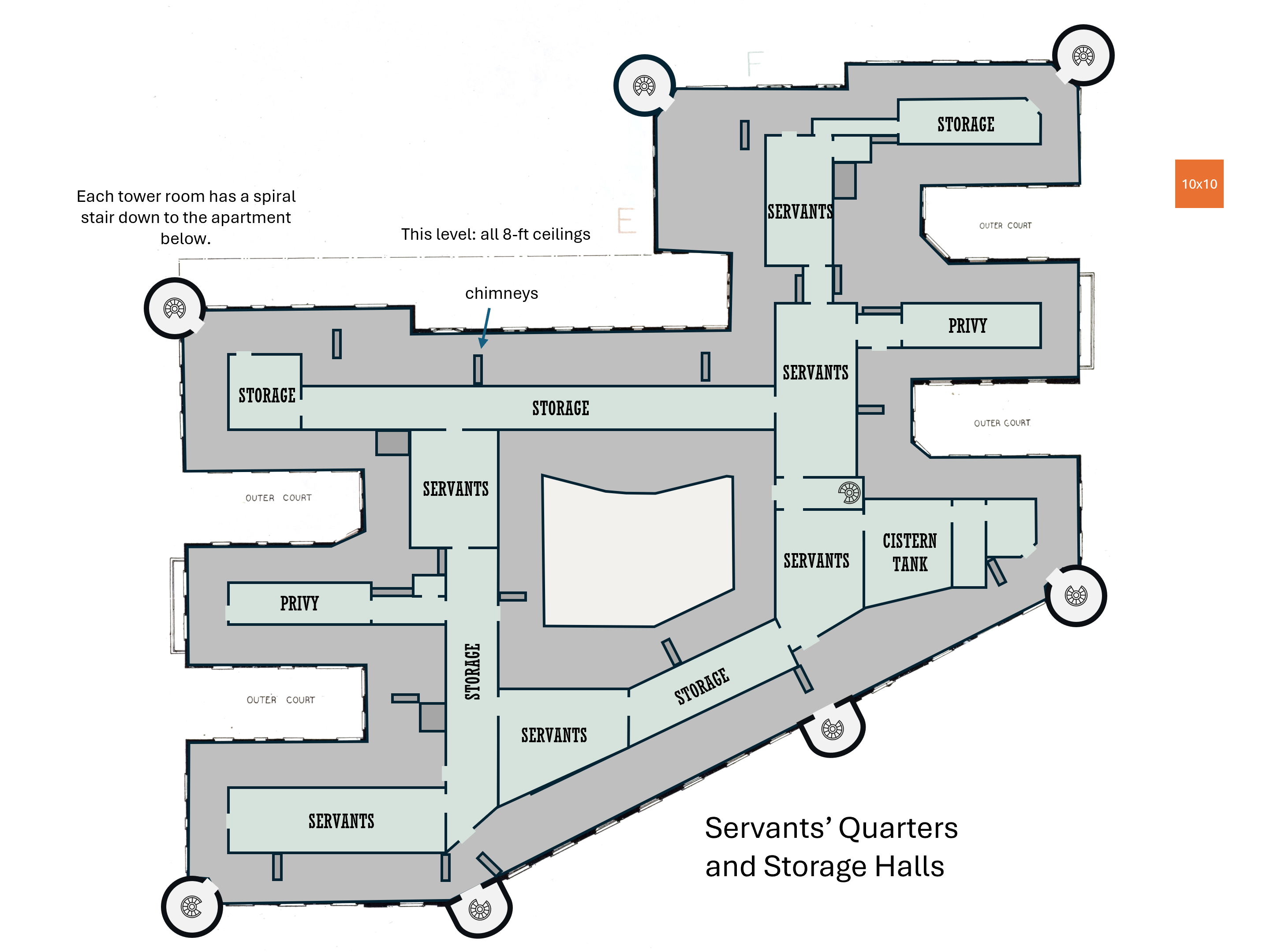
A while ago, I wrote about using real-life floor plans to create buildings for your fantasy RPG campaign that weren’t dungeons or castles. Here is one you can use as the basis of a school of sorcery in your realm. It’s based on the Hendrik Hudson Apartments building in New York City (but the overview is Crawfordton House in the north of England).
History
The Hendrik College of Sorcery is located outside the town of Swifford on a spacious campus once possessed by Harcor Hendrik, Archwizard of the Realm, ceded to him after the War of the Candles, in which his forces defeated those of his sister, Domma.
It was originally an addition to Hendrik Manor then took over the manor and was passed down a few generations before being granted its own charter by Queen Valizeth. It has since become a wealthy and respected institution nearly 400 years old.
The fields and pastures are managed by a reeve, who, along with the peasants, lives outside the curtain wall and would flee into the campus if attacked. The village of Hendrik includes the Hendrik Arms Inn, known by its sign depicting the coat of arms of the family. The college is in the process of extending its wall to encompass the village into Swifford and applying for a charter as a market town, which many feel is unlikely.
The school can accommodate a maximum of 99 students at a time, with 11 professors, and a headmaster and assistant headmaster. Its usual complement is closer to 65, with 7 professors.
Campus
Apart from Hendrik Hall itself, which is surrounded by its own curtain wall, there are several buildings on the campus, including:
- Stone-and-timber stable
- Barn of ancient construction that might have been a dwelling for ancient inhabitants
- Brick storehouse that was once a modest manor house
- Half-timber house for servants
- Half-timber cottage “plague house” for diseased or cursed persons; the plague house attendant lives here, isolated from the patient.
- Stone barracks house for 8 men-at-arms
- Stone chapel and rectory for the priest
- Stone cottage and shop for the blacksmith
- Half-timber cottage and shop for the carpenter
- Half-timber cottages for the stabler and groundskeeper
- Various sheds and outhouses
The campus also has:
- A pond called “Swordgrass Pool”
- Cemetery
- Summoning hill with a stone shelter
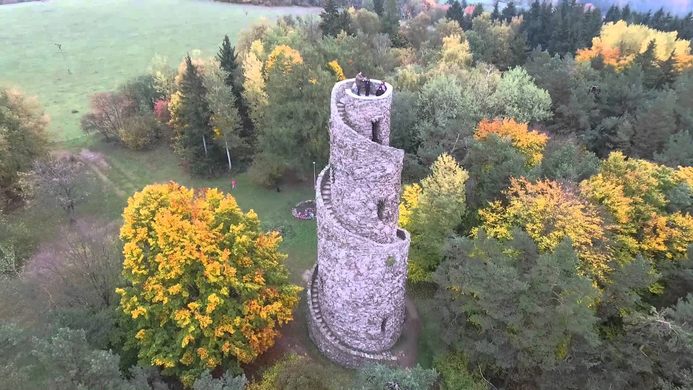
- A 100-foot watchtower with an exterior spiral staircase called “Scroll Tower”.
- Ruined old stone hall house called “the Old Hall”
- Grove of trees where at least two treants live
The campus is bounded by a steep ditch that is not well maintained and so a bit overgrown. A road passes by the campus, and a lane loops thru one gate to the main building and out another gate, both in good repair and locked at night. A lane wanders thru the campus, visiting each building, loops around the pond to the boathouse on the river, then meanders thru the woods to a third gate: rusted, locked, and in poor repair.
Security
The men-at-arms man the gates and patrol. During the day, there is one at each gate in the front (none at the old gate at the back) and two patrolling the grounds, mostly watching the ditch. During the night, there is one sentry at the curtain wall gate of the main building and two roaming the grounds. Each day, one man is off. Each gate has a bell to ring if they let visitors in.
During the day, the school porter spends a good deal of time inside the school entrance court, where he can keep an eye on the open curtain wall gate, but he attends to various tasks elsewhere as well, alerted by the main gate bell.
Students are tasked with watching for intruders and defending the school. Floors 3 and 4 each have a prefect and a sergeant; the sergeant makes a tour late at night, and the prefect makes a tour before dawn (and sometimes goes back to bed). However, they are mostly on the lookout for shenanigans, not sneak attack.
Various magical wards and constructs guard the school as well. At the pond is a golem in the form of a statue of Harcor Hendrik that asks passers-by the name of the institution; they must answer “Hendrik’s School” or it will attack them with its staff. Another golem statue–of Minervi Solta–stands in the lobby but must be activated by a code word from the staff, some of whom have forgotten it.
Hendrik Hall
The main building of the school is an imposing 4-story brick mansion with small towers on the corners. It is surrounded by its own 8-foot-high curtain wall in case of attack. But it’s not a castle; its defenses are meager and its walls thin by comparison. (The curtain wall is topped with spikes, not battlements.) It’s more of a tall, fortified manor house. The main entrance is on the east side. The south side faces the river.
The towers at the southern side entrances are hanging towers (that is, the towers don’t go down to the ground). The tower chambers have arrow loops for archers or wizards to shoot ranged attacks from–if things ever became so desperate. The large windows in the ground floor rooms are actually permanent walls of force. Windows higher up are leaded glass.
The exterior and courtyards are planted with pig bushes immediately next to the building. These are animate shrubbery with dense foliage that has an affinity for human and animal waste and convey it into a cavity in its trunks. This avoids a stink, since close stools emptied out the windows of the building drop their contents into the pig bushes, at least in theory.
The Ground Floor
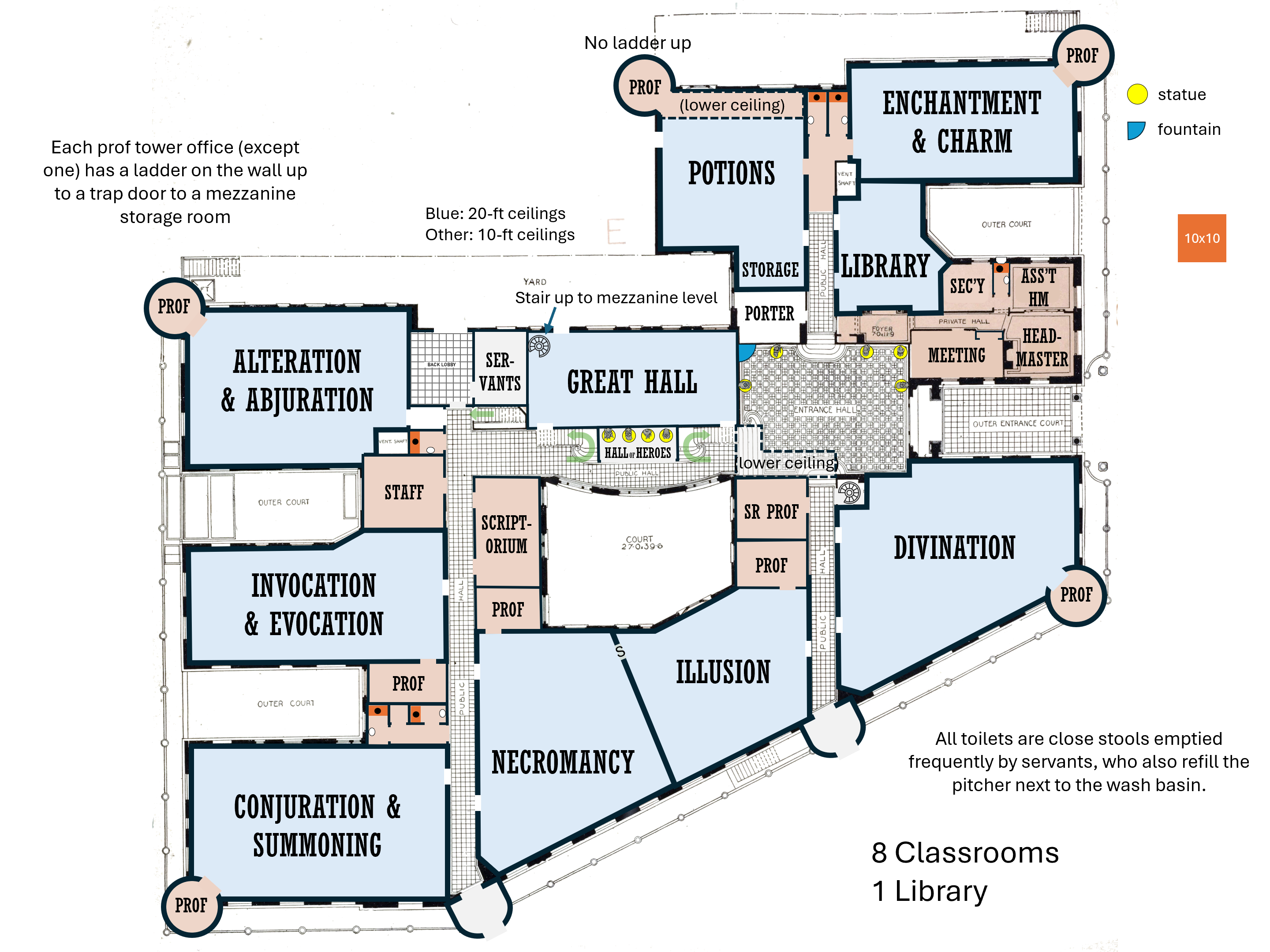
The main floor features eight classrooms, in which various masters teach particular types of magic at tables. The headmaster and assistant also have official chambers for work and meetings.
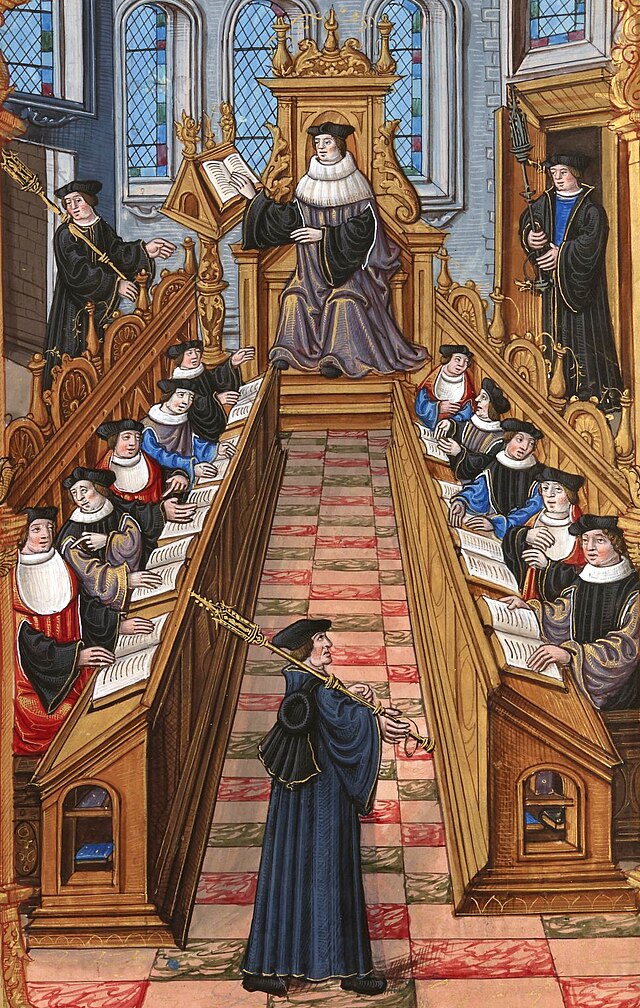
The classrooms are laid out either with the students along two sides, facing each other, or with students seated around tables, depending on whether the instruction is mainly lecture or laboratory. Note that each classroom has a small office for the professor, either in a tower chamber or an inner chamber.
Also here:
- A meeting chamber for the most senior professor (often borrowed by others)
- A staff room for less senior professors to socialize
- A library, in which the librarian fetches the books for students
- A hall for large conferences and staff dinners
- A group study room for students to meet in
- Chambers for the porter (who monitors and manages the comings and goings) and the school’s servants, altho their duties keep them roaming
- An entrance hall with a fountain and statues of respected personages
- A small “hall of heroes”, featuring statues of great masters of the school’s past
The library has no books on the main floor, only reading tables that the books get chained to so they don’t leave the room. The books are all in bookcases on the mezzanine level, each shelf locked by a bar. Only professors are allowed to browse the bookcases and to borrow books.
The First Floor Mezzanine

This is a partial level over the ground floor spaces that are not of double height. This includes kitchens, store rooms, and quarters for the servants of visitors; the kitchens hall is cluttered with various kitchen items and furniture used for staging prepared dishes. There is a door from the kitchens to a balcony overlooking the conference hall. A spiral stair allows servants to go up and down, and announcements are sometimes made from from balcony.
On a balcony mezzanine in the library, a secret door leads to a paneled hall of restricted books and other rooms. The Chamber of Whispers is a secret meeting room that is enchanted so that anything whispered is clearly heard by all, but it cannot be directly spoken of by them outside the chamber for a year and a day. There is a large mirror here that is a portal to and from a mirror in the private hall of the headmaster’s chambers below and a mirror in the private hall of his quarters. There is a password for each room.
The Second Floor

The second floor is the home of the private quarters of the professors who live and work at the school. Each apartment has foyer, parlor, bedchambers, study, dining room, kitchen, and servant’s chamber. In some cases, a professor’s servant is actually his or her apprentice. Some include a guest room, and visiting masters of the art are occasionally accommodated. The headmaster’s quarters include a laboratory for private experiments. A bathing/washing tub is kept in the kitchen.
The Third Floor
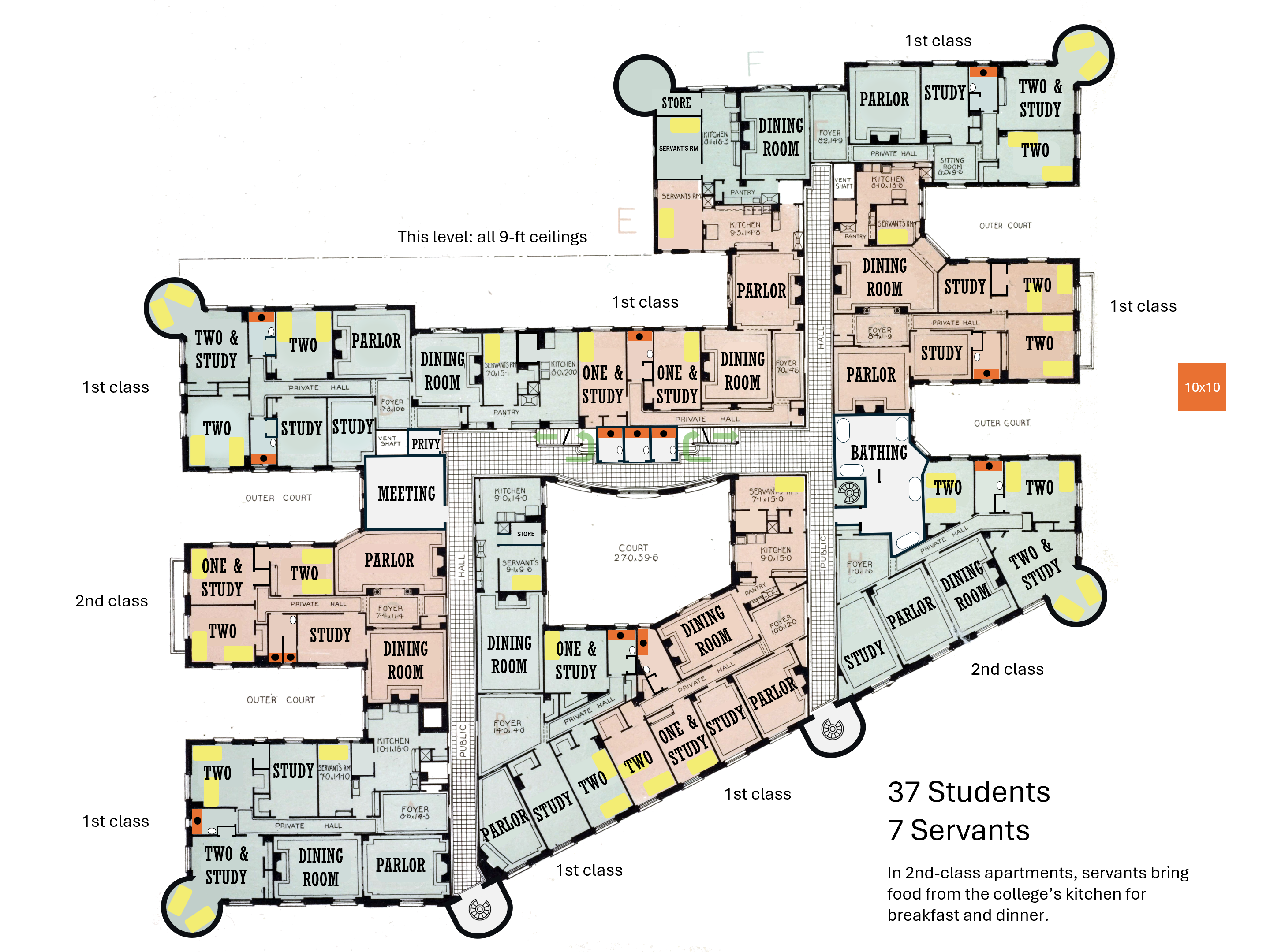
The third floor houses up to 37 of the school’s wealthier students in seven 1st-class apartments and two 2nd-class apartments. They are generally housed two to a bedchamber. The 1st-class apartments feature a kitchen and servant’s quarters; those in 2nd class apartments are fed from the school’s kitchens, like those on the floor above.
A bathing chamber is available on alternate nights for boys and girls, except for the holy day.
The Fourth Floor

This floor houses up to 62 students–mostly children of gentry or wealthy merchants. They are fed by servants from the kitchens on the ground floor mezzanine.
A bathing chamber is available on alternate nights for boys and girls, except for the holy day.
The Attics
There are extensive attics above the fourth floor under the roof. This is a maze of cramped spaces, the location of quarters for some of the school’s servants. Various furniture, junk, and antiques are stored there in long chambers with wooden beams at odd angles, and certain monsters could be lodging there. There is also a cistern filled by water from the underground river in the dungeon; the drains in the building are deposited into this same river downstream.
There are several doors to access to a broad parapet walk along the outside and the inner courtyard, for a garrison. However, the school’s men-at-arms don’t come up here, so it’s mainly a place to hang laundry.
The Dungeons
Under the school’s main building is a complex of dungeon passages, ritual chambers, a cistern, store rooms, and crypts that ultimately connect to natural caverns that exit in the wastes far away from the building. You can find examples of this sort of thing at Dyson’s Dodecahedron.
Among the dungeon chambers is one that is a portal to an ice cave in the frozen North, used to store foodstuffs. At least one other is a stasis cell for a monster the wizards thought might be of use one day.
An underground river runs thru the dungeons. A water wheel pumps water into the dungeon cistern and up to the attic cistern. Attic cistern only feeds the kitchens, and servants deliver water from there to their rooms.
In Use or in Ruins?
You could use these floor plans in an adventure where your heroes visit Hendrik College while it’s in use, and they merely meet with the headmaster or one of the professors. Or they might need to solve a mystery there, help defend the place from attack, or be asked to explore the dungeons and remove some odious creatures.
Or you could have them explore it as part of an adventure when it lies in ruins, having just been ransacked and left abandoned or else having long lain empty after a catastrophe. You would need to decide which parts remain intact, what monsters have moved in, and where treasures might lie. Is there a gruesome severed head among the busts in the Hall of Heroes? Are there survivors hiding on the mezzanine level or in the secret chambers accessed thru the library?
Comparison: University College at Oxford University
Each college at Oxford was basically one main building with a handful of smaller buildings (and originally independent of each other), much like Hendrik. The town of Oxford had a curtain wall encompassing it and even had a castle ruins on the west side (labeled “castle enceinte“). The colleges grew to dominate the town. Hendrik, on the other hand, is located outside Swifford on Hendrik manorial lands.
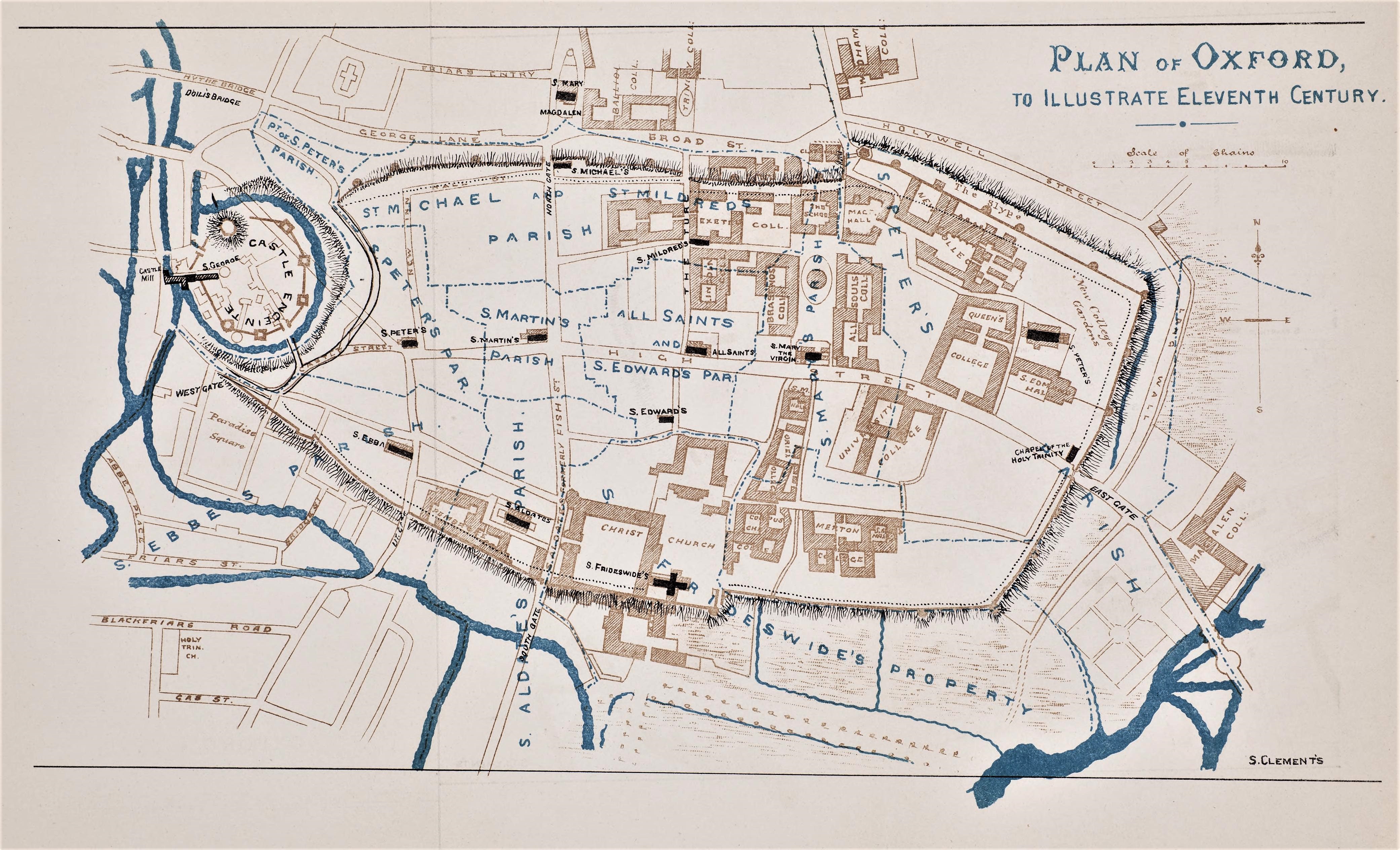
University College was one of first colleges at Oxford. The main building is about the same size as Hendrik. Because it was built inside a town, its other buildings are pressed up against it and fewer in number, because some of what Hendrik needs is unnecessary in a town. Some colleges at Oxford have extensive lands while others have quite modest endowments.

 zarban.com
Leave a comment