


Dungeon Coach’s DC20 and MCDM’s Draw Steel continue their journeys into creating new fantasy TTRPGs to rival Dungeons & Dragons. But they also continue the legacy of modern RPGs in general which, I think, might be fundamentally flawed.
The primary differences I see between old-school systems and modern systems are twofold:
- Depth of character creation
- Focus of game play style
Character Creation
Old-school systems like Old-School Essentials and Shadowdark don’t offer a lot of character-build options and instead tend to offer a small set of unchanging features. Choices are, for unclear reasons, reserved for spellcasters’ spells. In AD&D, fighters got access to all armor and weapons and a second attack at 7th level and “followers” at 9th level… and that was about it.
Modern systems are all about character builds. They offer predetermined class features, feats that players select, and a menu of skills. Often, a character in one class can choose a couple of features belonging to another class. There’s a lot of talk about “letting you build exactly the character you imagine.” *
* That’s why D&D introduced the tortle as a playable class—so players could choose to play a tortle monk who loves martial arts and pizza and says “cowabunga”.

This creates a system where a player’s mastery of the rules allows him or her to build a more powerful character than a new player can. That’s bad. It comes, of course, from Magic the Gathering. MtG is all about building a deck that can produce wicked combos. And starting with 3rd Edition, WotC turned D&D into the RPG equivalent of a deck-builder, except they deck your building is your character.
But power gamers who love optimizing their character will never be satisfied. That’s why the 2024 update to D&D has more and more character options: WotC asked players what they wanted, and the survey responses were “more! more! more!” Such players don’t care about game balance or about overwhelming new players. As Soren Johnson observed, given the opportunity, players will optimize the fun out of a game.
The challenges to be found in D&D should be in the adventure. You like treating the rules like a puzzle to be solved? Solve the puzzles presented to your character.
Play Style 1: Gridded Combat
Old-school systems tend to focus on exploration and complications, with plenty of combat third, and social encounters a distant fourth (or third, depending on how many pillars you think there are). Before 3rd Edition, D&D treated movement as something to track while moving thru a dungeon. Combat was mostly theater-of-the-mind, with the only rule for movement during combat being that you can move up to half your movement rate and still attack.
Modern systems tie movement directly to combat, often explicitly specifying movement on a grid in squares (D&D 4e, Pathfinder 2e, and MCDM) or 5-foot increments (D&D 5e and most others). D&D was created by wargamers who specifically chose to abandon the grid; why adopt it and turn D&D into a wargame?!
All this means that combat is naturally their primary focus, with social encounters next, then complications, and exploration last. MCDM’s Backer Kit states all this explicitly.
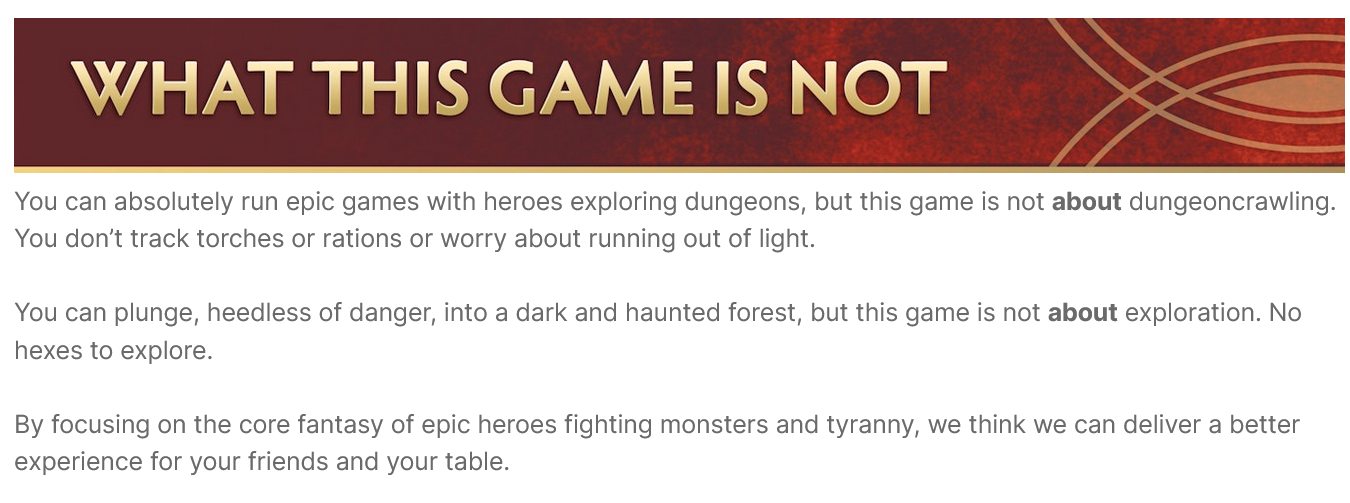
This led to the system trying to provide rules for every kind of combat event, which spilled over to providing rules for every other kind of event. This isn’t actually possible, however, so players (and GMs) can often feel hemmed in by piles of rules they can’t internalize or a lack of a rule to cover a specific event.
This goes both ways, tho. I recall moments in playing AD&D 2e in which a player felt there was nothing he could do but swing an axe, because the rules didn’t provide explicit options other than that (and engaging in grappling, but it had awful rules). So even old-school-style systems need rules to help the player be creative and the GM to adjudicate those ideas easily and consistently. Check out my fix for AD&D 2e.
Play Style 2: Every Round Is a Puzzle
With all the actions and options available to characters, every combat round is a puzzle players need to solve to find the optimal play. This slows the game and is boring for all the other players. You can have multiple actions each round (Pathfinder 2 and DC20) or action/reaction/bonus action (D&D). But you also have the option to use some feat, like action surge, of which you might have several or even, in 5.5e, drink a potion (while also still attacking and defending combat!). Spellcasters can cast a spell every round, which creates some analysis paralysis.
In old-school D&D, characters had virtually no choice—swing your sword or don’t; only spellcasters had real choices, and their paltry number of spells meant even those choices were limited. That’s not perfect either, but at least it was fast. If you want to drink a potion, do it before initiative is called or after you’re out of harm’s way.
Play Style 3: The Adventure Never Ends
The other aspect of modern adventure gaming is linking every “adventure” to an overall goal to defeat some grand overarching villain or solve some oppressive problem. This is a campaign’s central tension writ large, where everything relates to it. Side quests seem irrelevant, and random encounters are annoying, because they only get in the way of the Great Conclusion of the Story.
To be fair, this wasn’t originated by Wizards of the Coast. It started in minor ways under TSR with Ravenloft and other big adventures, but it only really got going with the advent of Critical Role, I think. Fans wanted to emulate the grand, overarching narrative and expected their local DM to provide it.
But Wizards of the Coast doesn’t publish normal adventure modules anymore but rather insists on publishing big books that are basically an entire campaign. Play drags on session after session, players drown in the story, and DMs have a hard time juggling all the moving pieces. Matt Colville has addressed this.
As a result, 5e DMs now complain of overwork and burnout. Players complain of railroading by a DM who’s trying to keep a complicated story on track. And some gamers turn to OSR systems for respite.
But you don’t have to play 5e this way. There’s a lot of dungeon-crawling advice in the rule books (well, the 2014 rule books) and not a lot of overarching narrative advice. The narrative stuff is driven more by Critical Role and other YouTubers. Ginny Di and Antonio Demico have both said that their campaigns take over a year to play but only cover a few weeks of game time. Imagine: from zero to hero to superhero in a few weeks! Does that make sense?? It’s because they’re playing out a narrative, which doesn’t allow for downtime or even much player agency beyond the character builds.
If every adventure sends the heroes headlong into the next to solve a new problem or get the next piece of the Harperstone to stop the Winter Witch or whatever, then there’s no time for training, studying, researching, crafting, or life events of any kind, including building a bastion. Bastion rules (what we used to call “strongholds”) are greatly enhanced in the 2024 books, so maybe players will request more downtime, but Ginny and Antonio both worry about how to fit them in, given that their game calendar moves so slowly.
The lack of downtime seems to have fed this weird custom of leveling up at the end of a session or even in the middle of a session instead of the end of the adventure, because there is no end to the adventure. You always have to race off to the next task.
I strongly recommend that if you’re going to try to play out a story like this, you should skip the details.
- Eliminate random encounters.
- Don’t play out NPC conversations (just tell the players what they learn).
- Keep combats short by having wounded opponents run away.
But also look for places where you can say the heroes have a bunch of time while they search for the location of the evil temple or whatever, and shoehorn in some downtime activities there (leveling up, especially). Movies do this with montages; what is a training montage but a leveling up scene?
The Result
As a result, old-school games present adventures as mysteries to be explored and puzzles to be solved. Dungeons were often (especially early on) crazy, nonsensical funhouses of peril. We never talked about railroading in the old days. The adventure was whatever the DM prepared (or the players asked for); the story was whatever the characters did. Treasures were often rolled up randomly, adding a tinge of gambling to the adventure.
Modern game play style (perhaps influenced more by Critical Role than by the rule set) put a lot more emphasis on story, and therefore a lot more burden on game masters to come up with a story for players to walk thru, discovering not the twists and turns of a dungeon but the twists and turns of NPC alliances and relationships. This can turn into a railroad, as the GM focuses on getting the heroes to follow the The Story.
Modern GMs often complain of being unable to challenge their players, because their characters do too much damage too quickly. But that’s not really the problem. Combat in old-school games doesn’t last much longer (in terms of rounds). It’s just that combat is only one way to deal with encounters. It’s common in old-school games for the players to realize their enemy is more powerful than they are, so they negotiate or run away.
In modern games, such an encounter could easily become a total party kill. “TPK” is a term I’d never heard until I looked into the modern game. It’s the sort of thing that happens because your players have become murder-hoboes (another term that was unknown in the TSR days) and assume they can kill anything they encounter. This kind of play in the old days was derided as boring “hack and slash,” and it was the DM who was blamed, because players weren’t presented with situations they couldn’t fireball their way out of.
It’s often said that the modern game tells stories about heroes becoming superheroes while the old game tells stories about zeroes becoming heroes. But that’s not quite true. There were plenty of superheroes in the old game. Gygax allowed for characters to reach beyond 20th level, and they got involved in all manner of politics, warfare, crafting, and such. (Bigby, Tenser, and Mordenkainen were player characters who created spells that immortalize their names.) And he was known to start them at 3rd level, so they were already heroes. I think this is because—not to put too fine a point on it—that Gygax ran a pretty hack-and-slash table. “Caves of Chaos” is pretty much all combat against various humanoids; compare it to the original first adventure “In Search of the Unknown“, which is loaded with tricks, traps, puzzles, and predicaments.
The Consequences
I think that the emphasis of modern games on character builds creates a culture of damage-per-round power gaming, which—together with movement rules and other aspects of play style—tilts the play heavily toward combat and away from problem solving. And combat is frankly boring. Look at all the YouTubers spewing advice about how to speed up modern combat and make combat more interesting. Modern combat is all about min-maxing your movement and “actions” on the grid, while old-school combat is just about rolling dice to accomplish your goal in the encounter.
Yes, old-school combat should—and can—be more interesting (especially for fighters, of all people). Dungeon Crawl Classics features “mighty deeds of arms” to encourage players to get more creative with their melee choices. I call this Daring Feats, and I also allow for a few feat-like class feature choices. But not having a ton of cool combat capabilities gives players less incentive to leap into combat at the drop of a hat.
Moreover, you can make your old-school game feature more story and more social encounters to satisfy the non-nerds who just love talking to NPCs (not to mention falling in love with and marrying them). All the drama that makes Critical Role so popular can be done in old-school systems (even romance), altho not all of it should (it’s too much work and isn’t a game but some sort of weird improv theater).
But all the exploration and problem-solving that makes old-school systems so rewarding can’t be done in modern systems—not easily, at least. As Matt Colville admits for his MCDM system, they just aren’t designed for hex crawls and dungeon crawls. The movement system is combat-based, not exploration-based. The skills often obviate things like getting lost, running low on provisions, and even searching a room. Modern systems feature things like perception checks and athletics checks instead of, you know, deciding what you’re character is actively doing to solve a problem.
Therefore, ironically, after 50 years, the modern game, with all its choices and focus on combat and storytelling, and all its cleanup of the mechanics, is actually a significantly worse game than how it started.
Now, as stated, the old systems aren’t perfect, and even modern versions of the old-school esthetic, like Shadowdark and DCC could use some tweaking to make them more more palatable to modern players. I feel like Low Fantasy Gaming and my changes to 2e do just that.
Add some story to make your dungeons make sense instead of being loony funhouses. And add some tactical options. Just be careful not to go too far and add in so much combat cruft that you turn your heroes into murder-hoboes or so much story and drama that you turn your campaign into a railroad full of prophecies and non-optional duties.


Leave a comment