

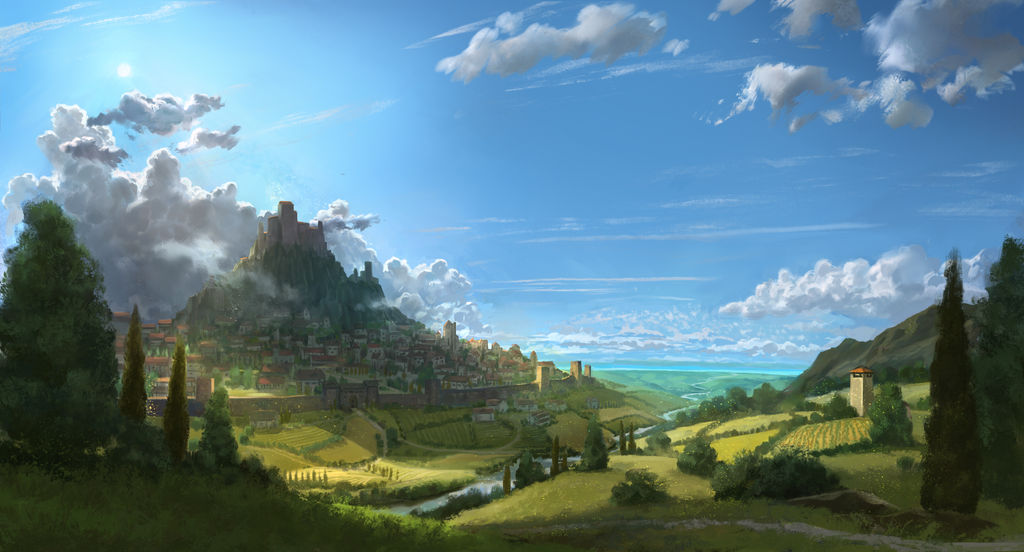
More than two years ago, I wrote about medieval town demographics. Since then, I’ve done more research and math and come to a conclusion of how exactly to use them to make realistic maps.
I like a 9-mile hex for a realm-scale map. This could be a work of art with a hex grid on top. Since travel on such a map is done by road and terrain is of no account on a road, it doesn’t matter that each hex isn’t a single terrain type. When creating an adventure map that covers one, two, or four 9-mile hexes, you would need to interpret the contents of a hex, which might have part of a forest, part of a moor, and part of lake in it. That tells you that your adventure-scale map with 1-mile hexes should reflect that mix.
Manors
A manor is about 1440 acres (2.25 square miles) and includes a manor house, village, church, mill, bakery, and forge, as well as a woodland and some wasteland not suitable for agricultural use. It has around 100 people. If attacked, the villagers will run to the manor house for protection and take up arms to defend it.
- 80 peasants, some of whom not only work the fields and tend livestock, but also build houses, thatch roofs, make charcoal, coppice trees, dig wells, shear sheep, butcher livestock, brew ale, repair shoes, etc. when opportunities arise. They also took turns acting as men-at-arms to protect the manor house.
- 10 are the priest, the reeve, the blacksmith, the baker, and their families.
- 10 are the lord’s household, meaning the lord or (if the lord lives elsewhere) steward, the bailiff, the forester, their families, and their servants.
- Some manors include a water or wind mill for grinding grain into flour, run by a miller.
- Some villages include a malt barn for malting grain to make ale or beer, overseen by a brewer.
- Some manors specialize in fishing, herding, raising horses, or mining. These are often smaller and have less arable land.
- Justice over disputes is dispensed by the lord/steward. Serious crimes are referred to the sheriff of the shire/county and court of law of the shire/county.
A 9-mile hex (70 square miles) contains about 31 manors, which support themselves and, collectively, about 533 non-agricultural workers, such as tradesmen, craftsmen, merchants, and officials. Since they needed a market to buy and sell goods and services, villages were nearly always within a few miles of a market town.
Towns
Peasants need somewhere to sell the fruits of their labor and buy goods they can’t make themselves. Therefore, towns spring up to within walking distance of local villages and get granted the privilege to hold a weekly market. These are walled for safety.
Towns are typically just 250-350 people, about half being peasants to work surrounding land.
- 125 craftsmen, tradesmen, and merchants and their families, all of whom are in the guild, which is required to sell goods and services. This amounts to about 25 households, so only common trades and crafts are represented.
- 10 to 15 are the bailiff, constable, a guild inspector or two, and their families.
- 120 peasants who work the fields and tend livestock of the manorial lands around the town. This is another 30 households.
- Some towns include a sage.
- In more rural shires/counties, a mere town might be the seat of governance and include the sheriff, judges, attorneys, and clerks of the court of law.
- A town may include or be located near a small castle of a minor noble (baron).
- So, a town might be just 55-60 dwellings and a handful of additional buildings, such as a church and guildhall. (Craftsmen, butchers, innkeepers, taverners, and such all live above their shops.)
Therefore, a 9-mile hex with one town could still support about 167 non-agricultural workers in cities and larger towns elsewhere.
| 1d6 | Contents of a Manorial Hex |
|---|---|
| 1 | About 31 manors and a coaching inn on a stretch of lonely road |
| 2-5 | About 28 manors and one market town |
| 6 | About 25 manors and two market towns |
Cities
A city starts at 2000 people and goes to around 70,000 for a capital city. (Greater than that is a metropolis, of which your known world should only have two or three.)
- While most who live in a city are tradesmen, craftsmen, merchants, and officials, some (perhaps 20%) are peasants who work fields and tend livestock outside the city. The peasants may live just outside the city walls, close enough to run to it if attacked.
- A city has more officials than a town, including those who represent the king directly.
- A city is typically the seat of governance of a shire/county.
- A city is more likely to include a castle belonging to a noble (a baron, or the earl who possesses the shire/county).
Populating Your Map
The population of a city has to be fed by manors surrounding it.
- A small city of 2000 needs 6.5 hexes of manors (and the market towns in them) to feed it.
- A medium city of 4000 needs 13 hexes of manors to feed it.
- A large city of 8,000 needs 26 hexes.
- A major city of 16,000 needs 52 hexes.
- A small capital of 32,000 needs 104 hexes.
- A large capital of 64,000 needs 209 hexes.
- A metropolis of 128,000 needs 414 hexes.
Therefore, if your kingdom has 25 small cities, 5 medium cities, 1 major city, and 1 capital, that’s (163+65+52+104) 384 manorial hexes are needed to feed themselves and the cities.
Since 384 divided by 32 cities is 12, each city (regardless of size) should be surrounded with 10 hexes of manors at minimum (including the hex it’s in). You might count a couple of hexes of lake or sea, since they’re sources of food.
Since the capital and large cities tend to be ports that sit on the coasts and do a lot of trade among themselves as well as foreign realms, some of them should sit closer to each other in a more developed region while other regions are more rural. For example, perhaps there are two large cities and the capital in the south, and one large city in the north, east, and midlands.
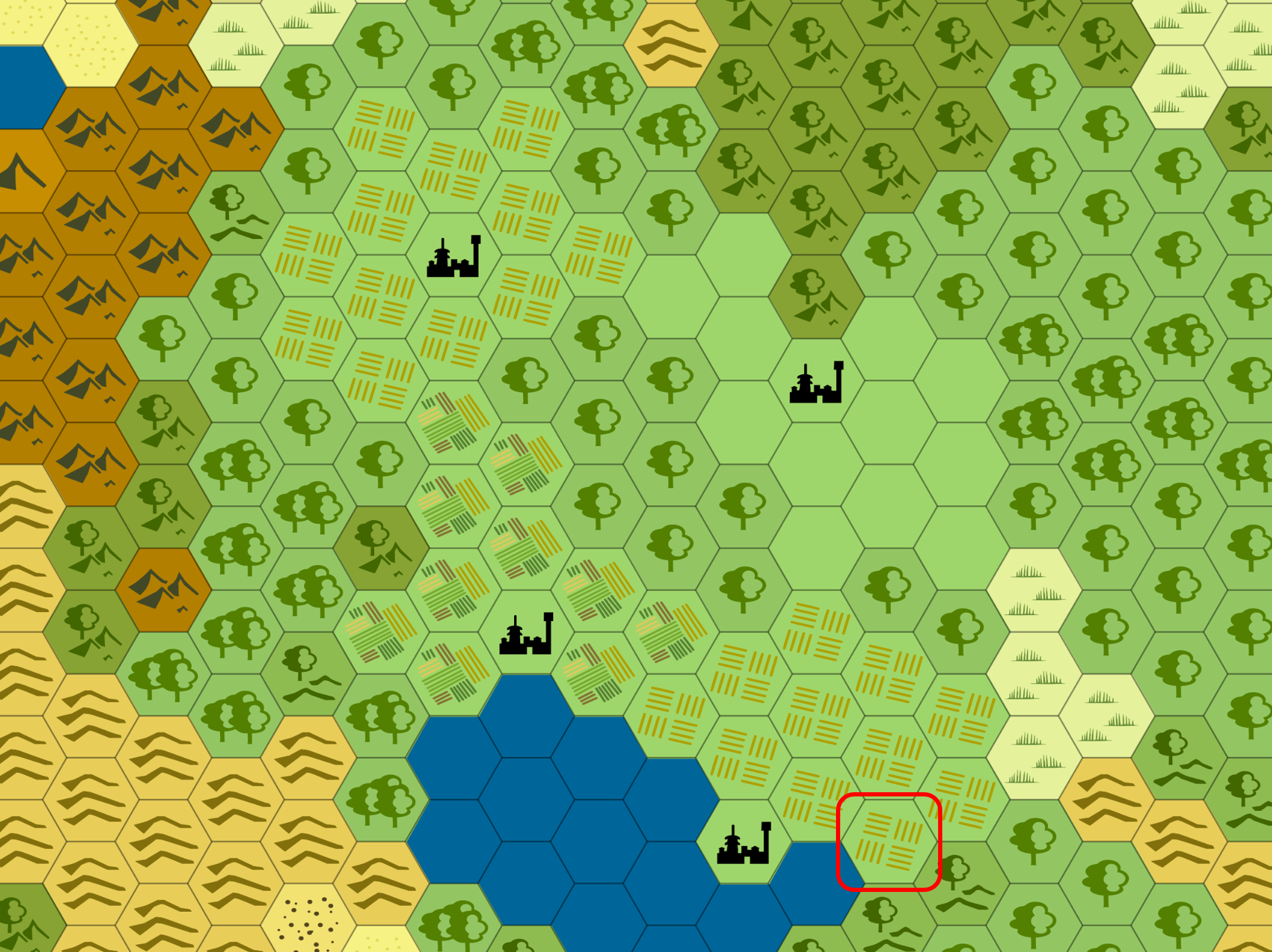
Note that the map above is an area of about 130 x 100 miles—an area larger than the Midlands of England and about the size of Belgium. With 18-mile travel days being common, it would take 2 to 3 days to travel from one city to another, staying at an inn in a town each night. (Remember that each manorial hex also has a town or two, or at least a coaching inn.)
Since the amount of wilderness has no bearing on the math of manorial-hexes-to-cities, you can add as much unsettled wilderness to your realm as you like. Just make the river valleys human lands, count the hexes of manorial land, and “spend” them to place cities.
Purpose: Two Scales for Travel & Exploration
The idea is for the heroes to own horses (and perhaps carriages) they use to travel on the realm map with 9-mile hexes from city to city as they hear about greater adventure opportunities. Then, when they reach the city or town nearest the Pit of Despair or whatever, they leave their horses and walk thru wilderness to the dungeon, using the adventure map with 1-mile hexes.
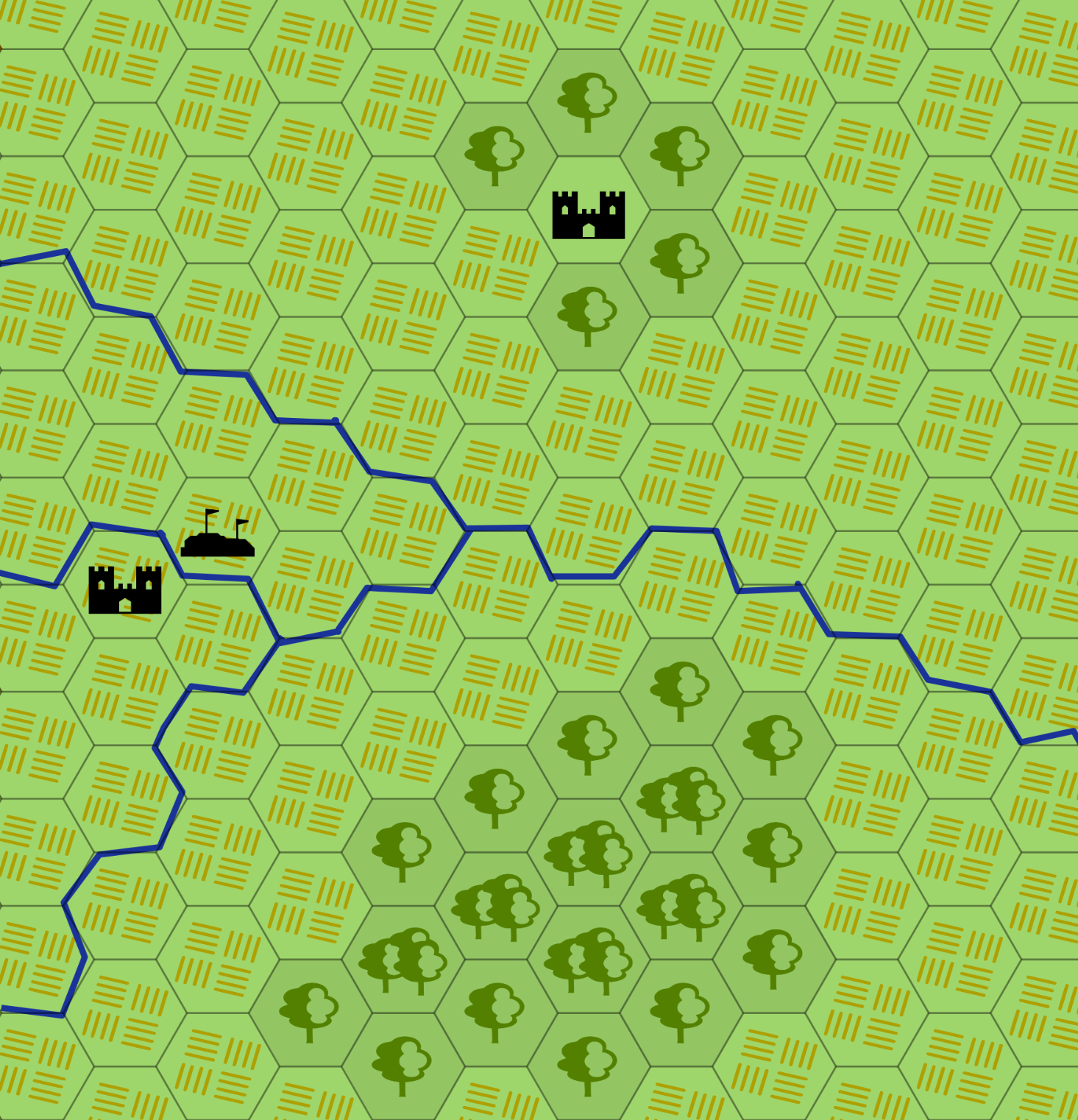
You can then populate your maps with minor points of interest according to terrain. Here’s a 1-mile scale map of the highlighted hex on the above 9-mile-scale map.
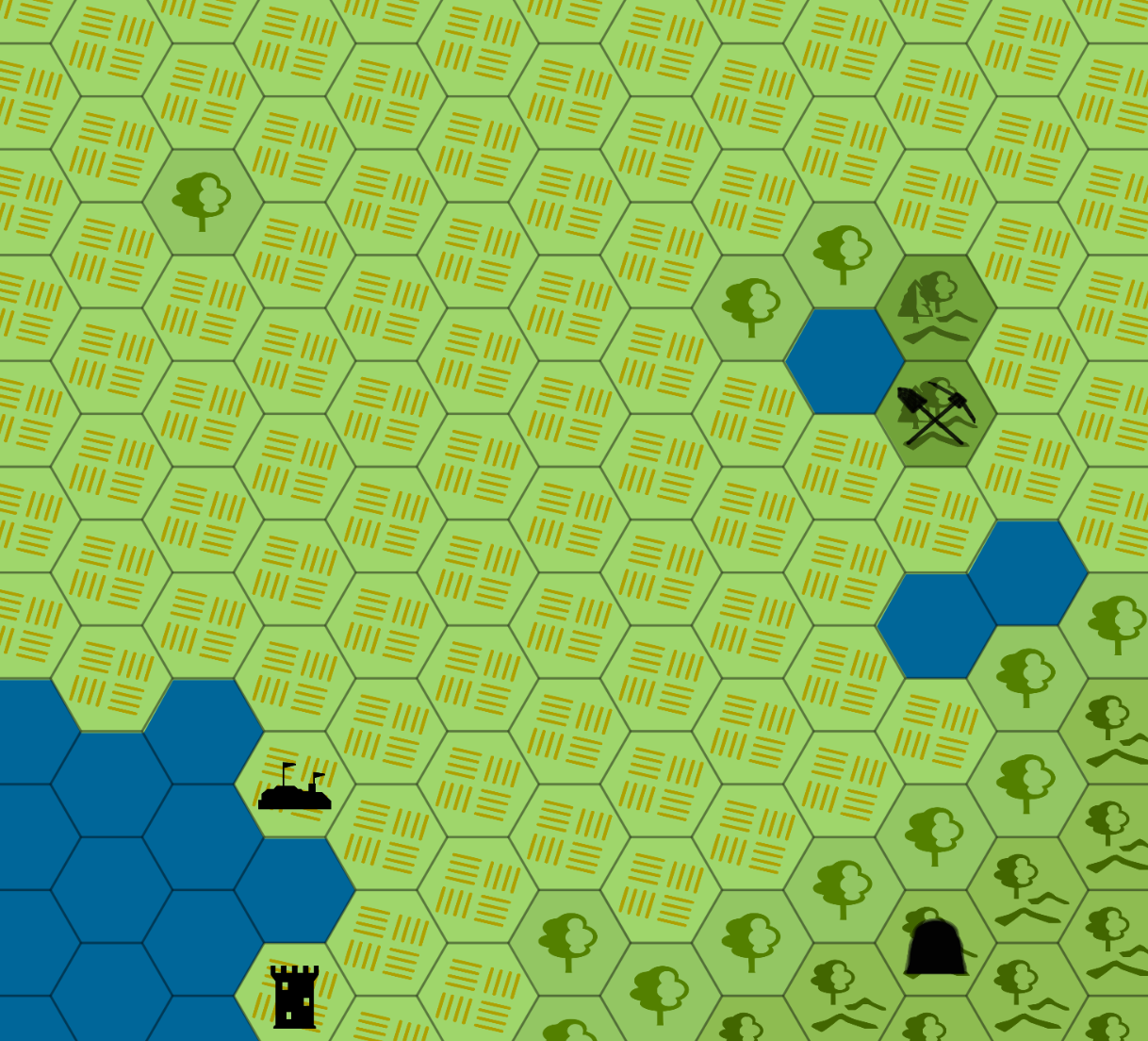
It should be easy to imagine creating a similar map dominated instead by forest or hills.
Comparison to Old England
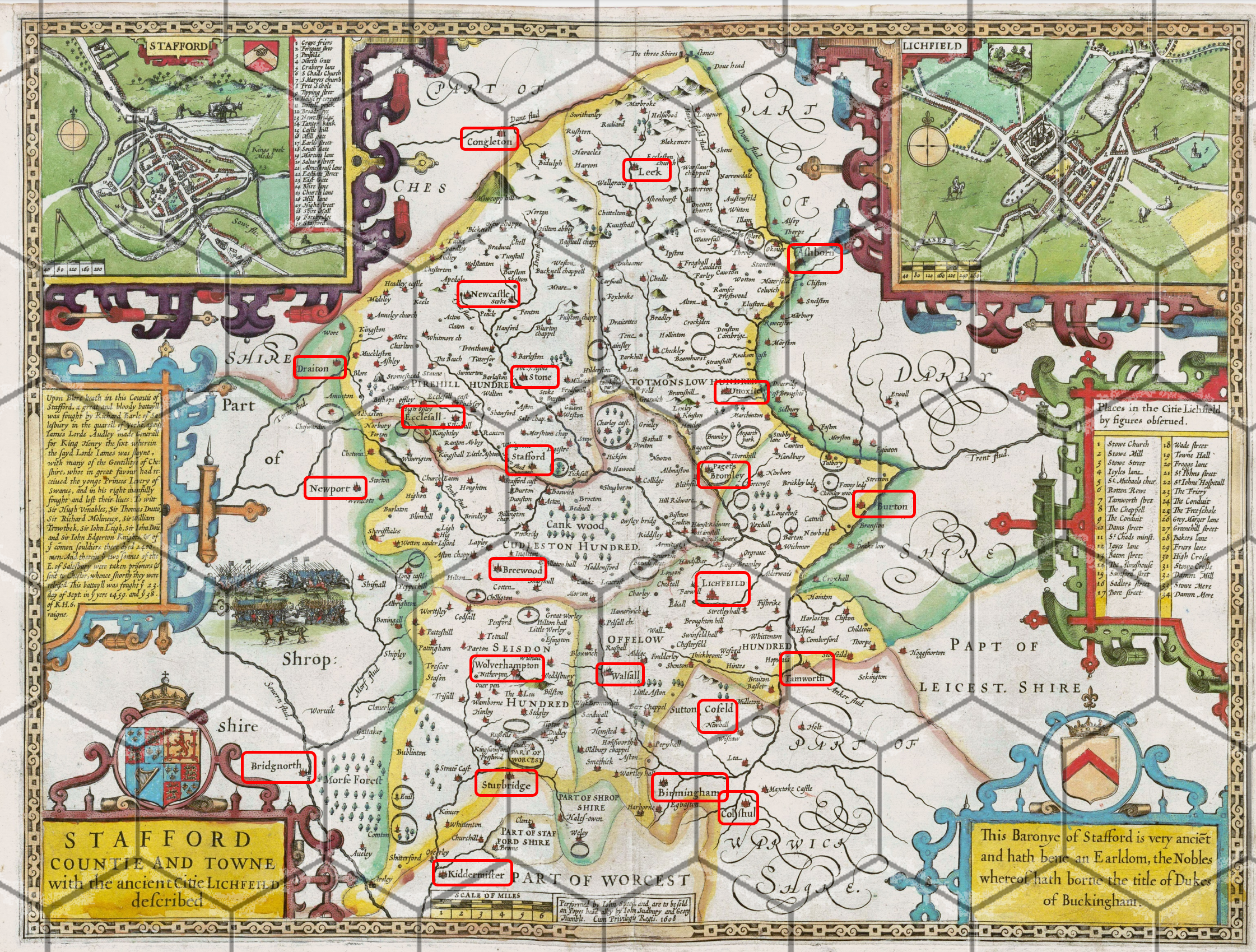
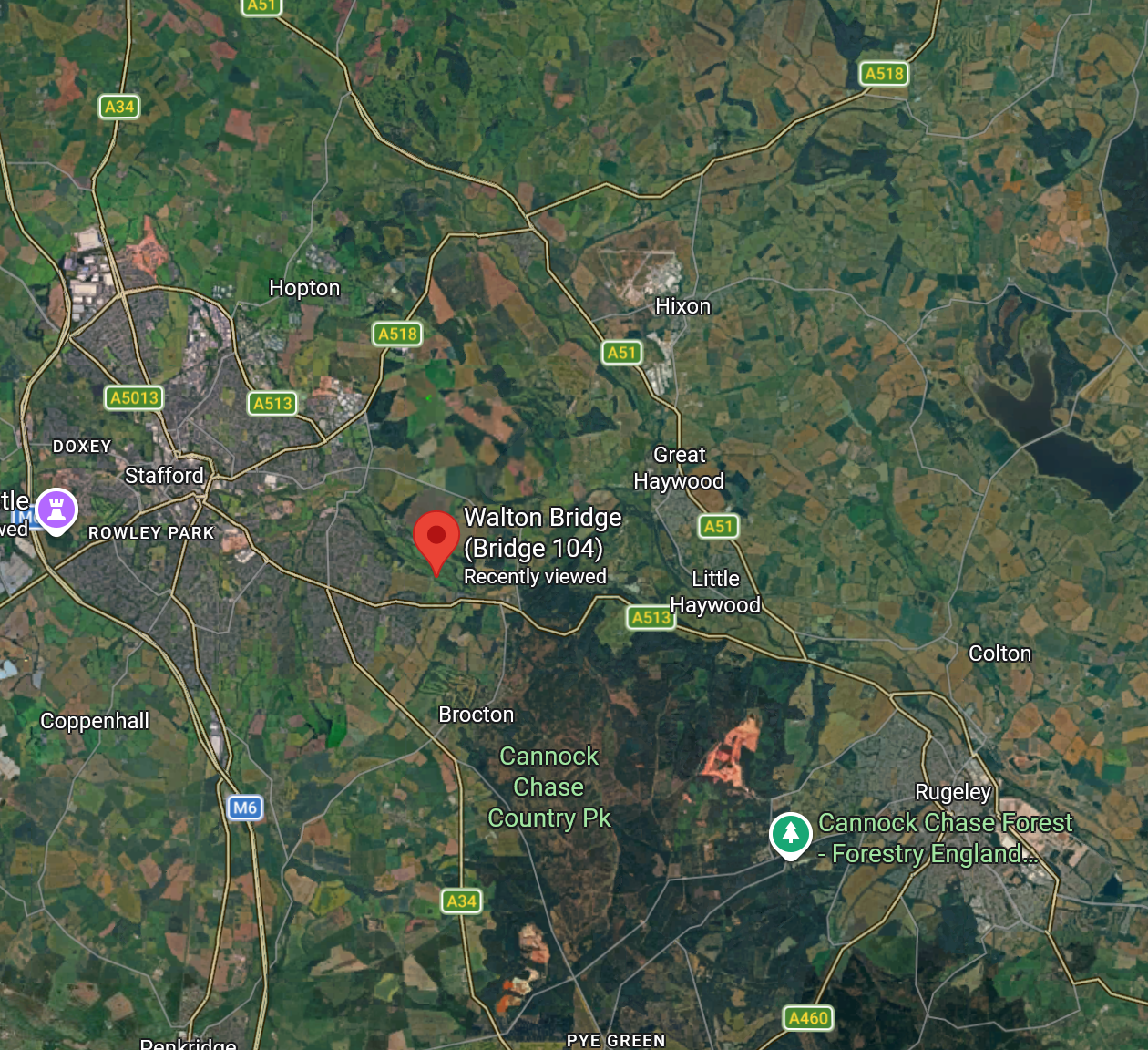
Below is a 1608 map of Staffordshire county, England, a barony and one-time earldom. It consists of 10 hexes with one or two towns in each and one small city: Lichfield. All hexes are manorial land. The Cank Wood (Cannock Chase today) was a substantial forest in the center hex.
All of England (not Wales or Scotland) is 720 hexes. In 1377 (according to the poll tax records of that year), these supported 31 cities, amounting to an urban populace of 157,000 (with just 35,000 in London). If 20% are peasants who work the surrounding land, this would require (by our calculations) 406 hexes of agricultural (manorial field and pasture) land. In the Middle Ages, just around 55% of England was agricultural land✽, or 27,665 square miles, or 396 hexes. That’s a very close match.
✽ Today, it’s 68%; quite high for Europe.
The Realm Map
Below is a map of England with 9-mile hexes marked with the various terrain fairly accurate to the Middle Ages. The amount of manorial farmland is calculated to match the requirements to feed the city folk using the above calculations and placed near cities and towns. The remaining hexes are marked as hilly moors, forest, moor, and marsh roughly matching the historical terrain.
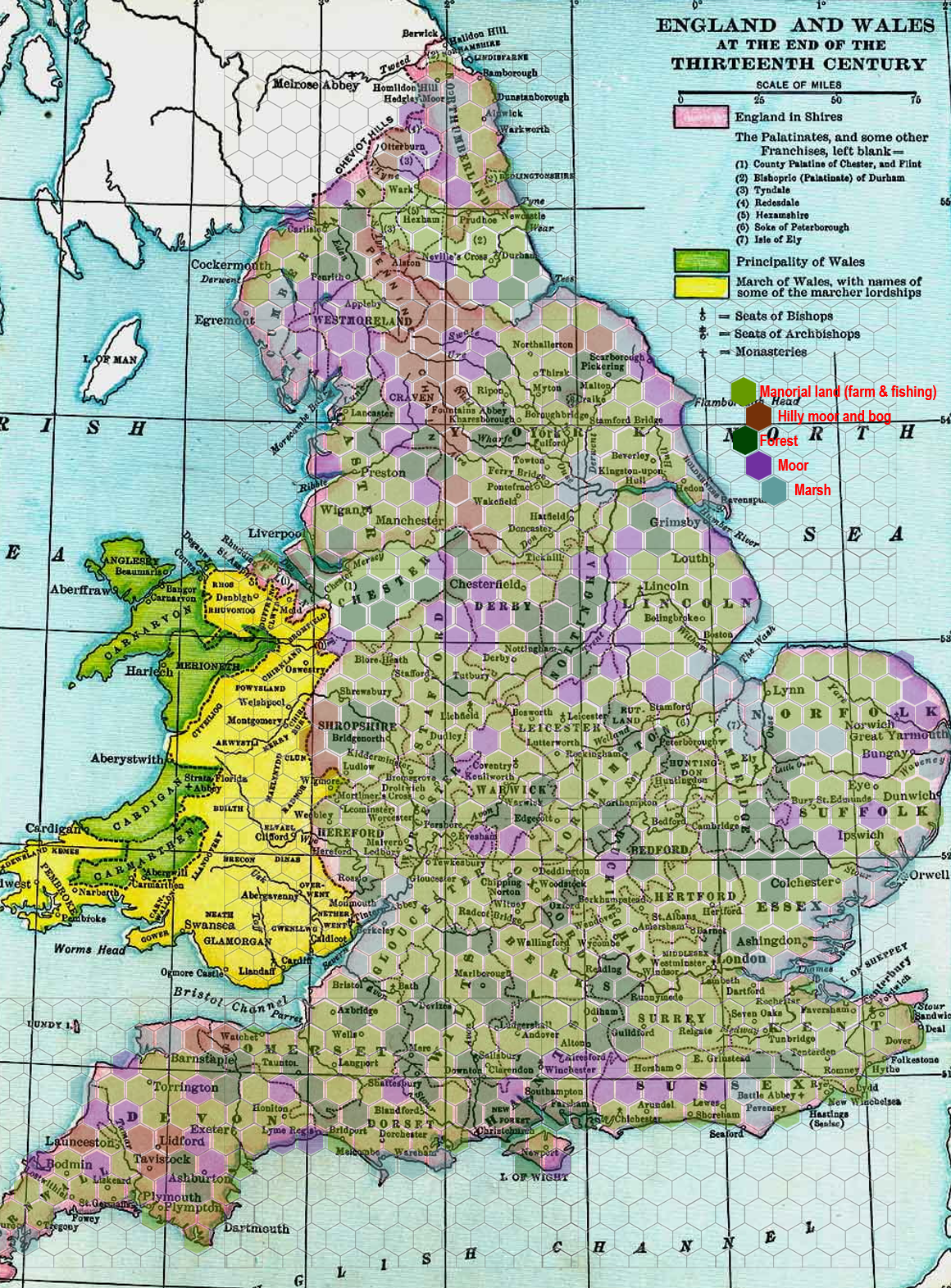
I feel like this sort of map would be a lot of fun to explore and travel. It’s a lot more settled farmland than most fantasy world maps, but that’s a plus. It means more travel is done by horse/carriage on roads. Then the heroes leave the town to go into the wilderness of the moors, marshes, forests, and hills, which are well scattered.


Leave a comment