

A year ago, I set out methods for hex crawls without the detailed rules I’d created the year before. This post presents a single, complete, methodical system for travel and exploration.
Known-World Map for Voyages
Your largest-scale of map should be a piece of art that has a scale but perhaps no hex grid. Use it to plot long voyages by sea (or air ship) between realms. Sailing and air ships travel at the mercy of the wind but are also fast or slow according to their design.
Assuming a competent crew, roll 2d6x10 miles each day plus the speed of the ship.
- Large ships have a speed of 0 or 10; medium ships are 10 or 20; small ships are 20 or 30.
- A nearly empty ship gets +10 miles per day.
- Air ships get +20 miles per day from more consistent wind at elevation.
If you use your 9-mile hex map for voyages, replace the 10-mile increments with hexes.
Realm-Scale Map for Travel
For long distance travel by road, create a realm map with 9-mile hexes. Add labels for the kingdoms and cities, as well as well-known perils. Major cities should be about four hexes apart in the primary trade area; ten in the hinterlands.
Roads
When you travel on a road on the big realm map, there’s no need to track provisions; there’s at least one town or coaching inn in every hex along the road. (If a road goes thru a depopulated area, treat it as a trail, which uses the random encounter table for the terrain type it’s in.)
Each day, healthy adventurers can walk up to three hexes.
- Each 9-mile hex costs 1 hp/level.
- You must make a save with CON modifier to avoid injury or stop or lose time resting.
- If you’re lightly/heavily encumbered, your first hex counts as if it’s your second/third.
Horses and pack animals are treated similarly, but they get 1 free hex unless heavily encumbered.
- They must save or become injured and need to rest the rest of the day or more.
- A horse or pack animal is encumbered when carrying 2 people and gear (or gear for 5).
- A horse or pack animal is encumbered when pulling a cart or carriage with 6 people and gear; a team of two can pull double that.
- If a horse or pack animal is reduced to zero hp by travel, it can go no further today and must make its save for the day (recover to need a full day to heal enough to continue) or else become permanently lame.
| Creature | Cost | Save | Failure |
|---|---|---|---|
| Person 1st hex (9 mi) | 1 hp/lvl | 3 | Injured. Recover to rest and go one more hex today. |
| Person 2nd hex (18 mi) or Lt encumbered 1st hex (9 mi) | +1 hp/lvl 2 hp/lvl | 4 | Injured. No recovery. Go no further today. |
| Person 3rd hex (27 mi) Lt encumbered 2nd hex (18 mi) Hy encumbered 1st hex (9 mi) | +1 hp/lvl +1 hp/lvl 3 hp/lvl | 5 | Injured. Recover or go no further tomorrow. |
| Horse, etc. 1st hex (9 mi) | free | (not heavily encumbered) | |
| Horse, etc. 2nd hex (18 mi) | 1d4 | 3 | Injured. Recover to rest and go one more hex today. |
| Horse, etc. 3rd hex (27 mi) | +1d4 | 4 | Injured. No recovery. Go no further today. |
| Horse, etc. 4th hex (36 mi) | +1d4 | 5 | Injured. Recover or go no further tomorrow. |
At the beginning of each day, roll for weather; stay one day ahead, so characters with nature lore skill know what the weather will be like the next day.
When the heroes enter a hex, roll for a random travel encounter. They automatically find any points of interest that are prominent (tall or near the road). (For those that are hidden, switch to a local, 1-mile hex map and go exploring.)
The towns and even cities can remain nameless unless the heroes stop; just have a couple of towns and cities pre-fabricated for those moments. On a road, the heroes will also pass thru a village every two or three miles, but they’re of no account; villages are little more than the collection of hovels where peasants on a manor live. Roads always cross rivers at a bridge, ferry, or easy ford.
Local Map for Exploration
For wilderness exploration on an adventure, create a local map with 1-mile hexes around the city where the heroes get information about the adventures to be had nearby (perhaps 21×18 hexes). The heroes spend terrain points to traverse 1-mile hexes, which vary in cost by terrain.
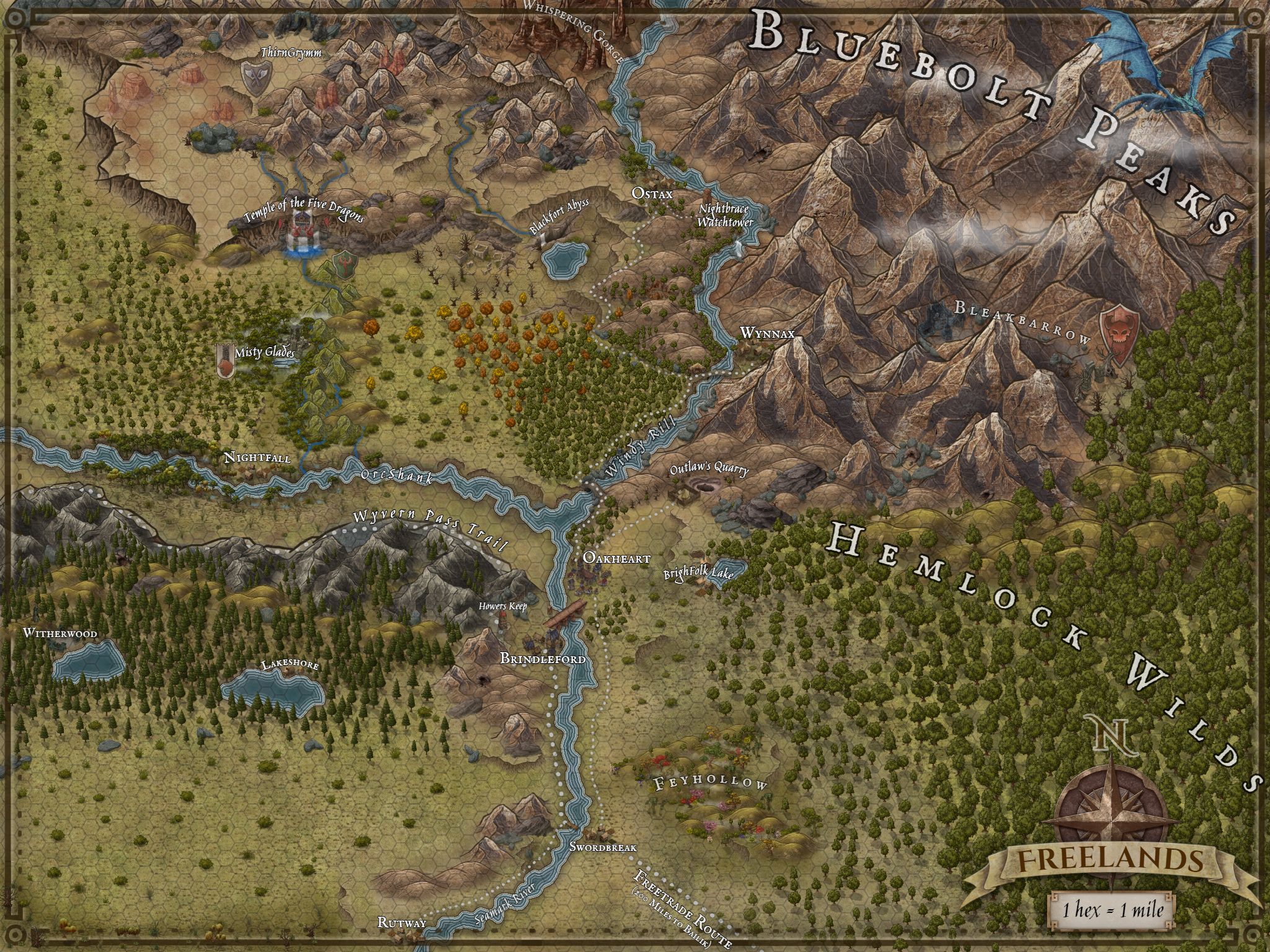
You can roll to determine if anything interesting is in any of the hexes they can see into, and they can choose to investigate minor points of interest or bypass them to get to the location they intended to seek out.
Daylight & Weather
First, decide what time of year it is. This will tell you how many hours of daylight they have, etc. Traveling at night is possible with torches or magic but should be more dangerous (not to mention exhausting), since many monsters are night hunters.
This isn’t crucial, but it helps avoid every adventure happening on a pleasant day in May, especially if you use my simple-but-realistic weather system.
Terrain Costs
Fit people (and horses) can only go a few hours before needing rest. So the amount of daylight is less relevant than the terrain and weather. You may want to use my difficult terrain navigation rules. A typical day is 9 hours of walking with occasional rests, which allows 18 points.
They can push themselves to get more points, but they’ll tire out much more, per the table below. If they have a couple of points left over, they can apply them to the next day. (In reality, they got part-way across an extra hex that day.) The party gets -3 terrain points if any among them is on foot and in heavy armor, smaller than size 4, or encumbered (additional penalties if more than one apply).
| Hours | Points | Cost |
|---|---|---|
| 4 | 10 | -1 hp per level |
| 9✽ | 18 | -2 hp per level |
| 15✽✽ | 26 | -3 hp per level |
✽ This is dawn to dusk in winter. ✽✽ This is dawn to dusk in summer.
| Terrain | Cost/1-mi Hex |
|---|---|
| Road or trail (non-mountain) | 1 |
| Moor, grassland, desert, or mountain road/trail | 2 |
| Forest, hills, forested hills, marsh | 3 |
| Mountains, swamp, forested mountains | 4 |
Roads & Trails
The heroes may spend part of an exploring day on a road, which has its own encounter table. Trails are just as easy to travel, but they aren’t safe, so they use the same random encounter tables as the terrain they go thru.
Finding Things
Visibility is best at noon on a day with clear weather. These figures assume clear weather and a viewer 5 to 6 feet tall.
- On a grassy plain or shrubby moor, the treeless horizon is 3 miles away.
- You can see a 50-foot tower atop a hill from 12 miles away (but it doesn’t rise above a treeline). From that tower, you can see 12 miles, barring trees and buildings.
- You can see a 150-foot tower standing above the trees 20 miles away.
- You can see the tops of most mountains from 60 miles away and big mountains from 120 miles away.
- Roads and trails thru hills and mountains provide excellent opportunities to see particularly long distances—as much as 12 miles when above the treetops.
Things that are actually hidden—like the entrance to a cave—must be found by directions or a guide. The locals—especially shepherds—know the environs like the back of their hands. Or you can search a hex by checking difficulty 15 using search or navigation skill.
- On a natural 20, they find it after spending the normal terrain points.
- On a success, they find it after spending 2x the terrain points.
- On a recovery, they find it after spending 3x the terrain points.
- On a failure, they find it only after spending 4x the terrain points.
- On a natural 1, they don’t find it at all.
Travel Trouble
Each hex, make a travel check against difficulty 11 using the leader’s navigation skill.
- Success means no time was wasted in crossing the hex.
- Recovery means wasting 1 terrain point wandering and backtracking, if the leader has navigation skill—or full points for the terrain, if the leader doesn’t.
- Failure means the heroes waste terrain points equal to the current hex cost, if the leader has navigation skill—or becomes lost, if the leader doesn’t.
- On a natural 1, the party becomes lost, even if the leader has navigation skill.
Becoming Lost
If lost, the heroes’ first hex of movement that day is in a random direction, but subsequent hexes of movement are in the correct direction. (This simulates getting a bit off track thruout the day, not literally going in the wrong direction and then correcting.)
The players should not know they’re lost that day and should plot their travel as if they’re on track. Since they’re likely in a different hex than they think they are, you will need to continue tracking their real location in secret. The party may only realize they’re lost when they believe they should have arrived at a destination, but it’s not there. They may able to get their bearings if they:
- Ask a local.
- Climb a big hill and look for a landmark.
- Stumble on a road or river.
- Stumble on a point of interest that appears on the map.
Minor Trouble
| 1d6 | Flat Ground | Hills or Mountains |
|---|---|---|
| 1 | A tree has fallen across the road or trail. Possible ambush point. | Fallen rocks block the way. Possible ambush point. |
| 2 | Due to a recent storm, a river is up (or a bridge is washed out), and the river is dangerous to ford. See Rivers. | Fallen rocks block the way. Possible ambush point. |
| 3 | A storm has washed out the road or trail, and it’s a knee-deep, watery, muddy mess. | The trail has eroded/crumbled, so a bluff must be scaled to continue. |
| 4 | A wooden bridge across a small river/dry ravine is decrepit and dangerous. | The trail has eroded/crumbled, so the gap must be bridged. |
| 5 | A burrowing monster (bulette, giant mole, purple worm…) has dug a 10-foot wide trench across the landscape in your way. | The trail has eroded/crumbled, so the gap must be bridged. |
| 6 | The area is a mucky bog or watery marsh. If following a road or trail, it’s a decrepit wooden causeway. | You’ve stumbled into a steep glen; back out or scale the slope. |
Rivers
Rivers are very significant natural barriers. Warn the players ahead of time that they need a plan for crossing substantial rivers. Roads will always cross at bridges, ferries (rare), and easy fording points (slow-moving water less than thigh-deep). As a general rule, if you show the river on your large-scale map, it’s too big to cross without a bridge, designated ford, or ferry. If the hex on the large-scale map doesn’t show the river, then any river on the small-scale map for that hex can be forded.
The heroes can ford streams easily enough as well as small rivers that have large stepping stones (either of which is common on a trail) but must build a raft or something to cross a larger river. They may be able to travel up or down a river to find a better crossing point (slower and shallower with a gentle bank).
- You can decide on the difficulty for a skill check (some nature or sporting skill) to cross or just roll 2d10 for a random difficulty.
- On a recovery, you slip but make it across with difficulty.
- On a failure, you lose your footing. If you aren’t weighed down by medium or heavy armor or a heavy pack, make a dexterity check to make it to the far side; on a recovery, you make it back to the starting side.
- If the heroes go up- or downstream to find a better place to cross, roll a new difficulty for each mile. On a low difficulty, they find:
- Where two smaller streams come together upstream; crossing each of them is much easier than crossing the larger stream.
- An island in the river, making crossing half the river to the island and then the other half easier than crossing the whole.
- A wider, shallower, and slower ford.


Leave a Reply