

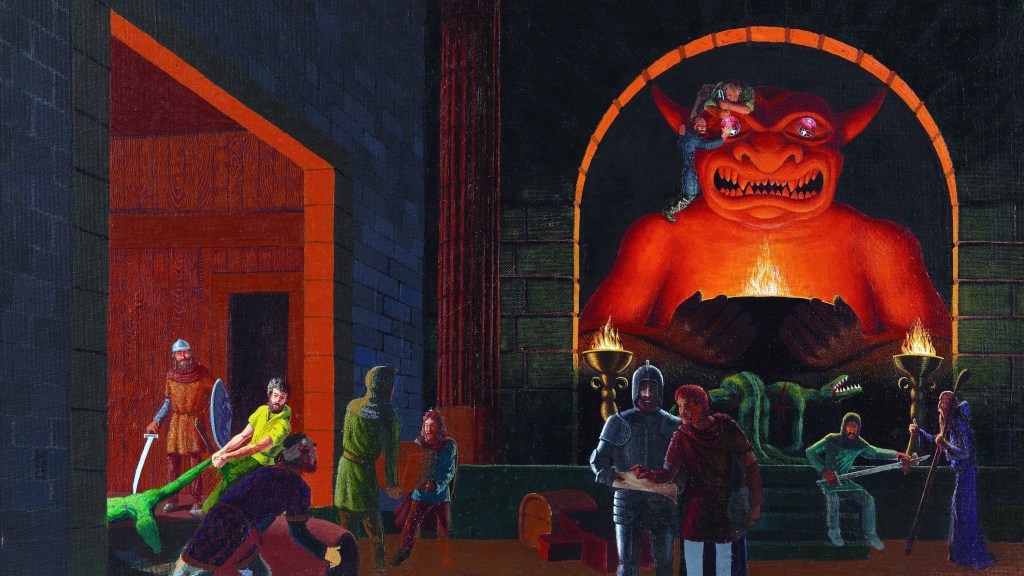
I often hear 5e players and GMs claim that old-school D&D from the TSR years was a “meat-grinder” and “much more lethal” and such, and I’m here to tell you: it’s just not true. I grew up with B/X, 1e, and lots and lots of 2e, and I’ve since played some 5e. There are a lot of misconceptions—perhaps driven as much by the OSR movement as 5e gamers themselves.
Since death happened at zero hp, old-school D&D PCs just stopped fighting before then. Modern gamers fight to the last hit point, because they know they have “spare the dying” and multiple death saves and all that. Then they imagine (or try playing) OSR systems the same way and get killed.
Character Creation
It’s certainly true that TSR-era D&D had easy character creation. You could throw together a non-spellcaster in a few minutes and be playing as soon as you thought of a name. But it’s not because you needed to be able to roll up a new character quickly to make up for PCs that were constantly getting struck down in combat. That rarely happened. As a DM in the early ’80s and early ’90s, I don’t think I killed more than three or four player characters—and I ran a low-magic game.
Most 5e players are prejudiced against easy character creation, because they love the character-building process of modern games, including Pathfinder, Nimble, and now Draw Steel and Daggerheart. But I’m here to tell you that that process is a conniving deceiver that will only confuse you and bog down your game later. You are solving the puzzle of character creation instead of puzzles in adventures.
Combat
Combat in old-school D&D is often characterized as a “lethal” by critics, a falsehood exaggerated by modern OSR-style games that make it so with a “funnel” concept specifically designed to kill off characters. But the old game had no such mechanism or goal. On the contrary, the great majority of characters survived as long as you wanted to play them, and various cleric spells were available to restore, reincarnate, or resurrect them, if necessary. Not only did I rarely kill characters, I don’t recall ever even needing to use those spells to bring a character back.
Why is that? I think it’s because I sent low-level characters on adventures that didn’t have a lot of combat in them. It’s as simple as that. If you design an adventure with plenty of tricks, traps, puzzles, and predicaments, with NPCs and creatures the heroes can talk to, you can provide plenty of challenge without putting them in much danger.
This is not to say we viewed combat as a “fail-state”. Our adventures soon had plenty of combat. We didn’t even need free health potions lying around every corner. By 3rd or 4th level, the cleric had enough healing to keep the PCs healthy.
Worse, D&D combat is boring. It’s true that old-school martial characters had no appreciable choices to make in combat, but at least the combat rounds went quickly. Indeed, the flexibility of the modern game’s “action economy” is a vampire sucking the life out of every round, as each player tries to maximize his or her turn. Non-D&D games like Draw Steel are said to make combat more fun, but their fights last just as long: too long. “Tactical combat” is code for “we make combat a puzzle, because we think you’re not good at thinking up puzzles to challenge your players.”
It Was Malleable
One major advantage that old-school D&D has over modern games is its malleability. It’s trivial to flip AC upside down and turn THAC0 into an attack bonus, and now you’ve got a modern-style, bigger-is-better, clean-as-a-whistle combat system. And now that you’ve eliminated the small amount of sand in the gears, you can enhance it in myriad ways without slowing combat down too much:
- Give martials a bonus they can shift from attack to damage to AC to nearby ally’s AC to represent how they’re fighting carefully, aggressively, or defensively from round to round or implement more robust tactical combat rules appropriate for an old-school system.
- Give characters a maneuver or reaction (half move, grapple, shove, drink a potion, etc.).
- Implement 5e-style checks for skills (or even my checks with recovery rolls).
- Implement my ferocious resistance rules for powerful monsters.
- Loosen up Vancian magic a little (but also reduce spellcaster power at high level).
- Not only make use of old-school reaction and morale rolls, but improve them.
- Improve injury and death and be more generous with healing.

 zarban.com
Leave a comment