

OSE is a great revival of old D&D, and the 2026 update is terrific, but the desire to keep it compatible with old-school D&D adventure modules means it still suffers from many of the same issues the old game had. There are, surprisingly, some simple ways to fix it without turning it into a hybrid with modern games, like I did with 2nd Edition.
Basics: Advanced
In general, use the advanced optional rules.
Character Creation
| Ability | Modifier |
|---|---|
| 1-3 | -3 |
| 4-5 | -2 |
| 6-8 | -1 |
| 9-12 | — |
| 13-15 | +1 |
| 16-17 | +2 |
| 18 | +3 |
Roll 2d6+6. This is your charisma. Roll 5 more times and assign these to the other abilities as you like. If no score is at least 15, raise your lowest score to 15. Choose one ability for an extra +1. You can swap charisma with another score to make charisma higher but not lower.
There’s a standard ability score modifier, at right.
The charisma modifier is used for reaction rolls, persuasion checks, negotiations, number of permanent magic items you can attune to, saves against charm and fear, and searches (not only do people like you, but you understand how they think).
Classes & Levels
All characters start at 2nd level with maximum hit points for their class. Thereafter, they get the average for their hit die, rounded up (3 for d4; 4 for a d6; 5 for d8; 6 for d10). If you choose to allow multi-classing (“hybrid classes”), those characters start at 1/1 with maximum hit points each class, per below. The valid hybrid classes:
- Arcane Warrior (fighter-mage); 5 hp/lvl; light and medium armor only
- Swashbuckler (fighter-rogue); 5 hp/lvl; light armor only; shield disallows rogue skills; barbarian’s agile fighting
- Witch (druid-mage); 4 hp/lvl; no tactical bonus
- Monk (cleric-rogue); 5 hp/lvl
- Charlatan (mage-thief); 4 hp/lvl
attack Bonuses
Attack bonuses are smoothed out. (“All?” refers to the possibility of giving the same bonus to all classes and using bigger tactical bonus to make the difference in their fighting abilities.)
| Level | Bard/Rog Cler/Dru | Barb/Ftr/ Knt/Pal/Ran | Ill/MU | All? |
|---|---|---|---|---|
| 1 | 0 | 0 | 0 | 0 |
| 2 | 0 | 1 | 0 | 0 |
| 3 | 1 | 2 | 0 | 1 |
| 4 | 1 | 2 | 1 | 1 |
| 5 | 2 | 3 | 1 | 2 |
| 6 | 2 | 3 | 2 | 2 |
| 7 | 3 | 4 | 2 | 3 |
| 8 | 4 | 5 | 3 | 3 |
| 9 | 4 | 6 | 3 | 4 |
| 10 | 5 | 6 | 3 | 4 |
| 11 | 5 | 7 | 4 | 5 |
| 12 | 6 | 8 | 4 | 5 |
| 13 | 6 | 8 | 5 | 6 |
| 14 | 7 | 9 | 5 | 6 |
Spellcasters
Import the idea of cantrips from 5e—zero-level spells that can be cast as often as once each round.
Mages
Give arcane spellcasters these cantrips:
- prestidigitation (per 5e)
- candlelight (produce a candle-like flame on your finger as long as you concentrate)
- magic dart (a single magic missile that does 1d4+1 damage; roll to hit)
Additionally…
- You can swap a spell you’ve memorized with another you know, but you must save vs spell or suffer a minor wild magic effect.
- In place of mundane spell components, you carry a custom-made staff, wand, or other sorcerous channel. Without it, you can only cast cantrips.
- Spell changes:
- fire ball does 4d6 damage (not 1d6 per level, but lightning bolt still does).
- sleep creates a normal sleep, so sleepers awaken with any normal noise or movement—meaning only those with move silently can attempt executions.
- Identify basically gives full knowledge of a magic item (except a cursed item).
- There’s no need for read magic. Spellcasters can just read magical writing and spellbooks because they know the language of magic.
Clerics & Druids
Give divine spellcasters these cantrips:
- thaumaturgy (per 5e)
- guidance (per 5e)
Additionally…
- Spend 10 minutes praying to swap a spell you’ve memorized with another you know.
- In place of mundane spell components, you carry a holy symbol. Without it, you can only cast cantrips.
Turn Undead: As your full action for the round, you can turn undead of a number of hit dice up to 1d6 plus your level, applied to the closest creatures first. You can do this to creatures of up to 2 HD more than you have levels. If you add an extra point beyond the creature’s HD, it is destroyed. (Example: You’re 3rd level and roll a 4; you can turn seven 1 HD undead, three 2 HD undead and apply the extra point to one of them to destroy it.)
Tactical Bonus
You get +1d3 you can add (each round of combat) to your attack, damage, armor class, or the AC of an ally within 5 feet. If you’re using a missile weapon, you can apply it only to your attack.
Martial Classes
Monster lore: The fighter, barbarian, and ranger get this skill. Make a successful check to identify a never-before-seen creature from old warriors’ tales (per DM) and recall a special ability or vulnerability it has. Fail but roll a successful recovery: you know little more than its common name. Difficulty is 8 plus its hit dice. Certain creatures (goblins, dragons, etc.) are well known.
Chivalric lore: The knight and paladin get this skill. Make a successful check to identify a magical weapon, armor, shield, etc. by recalling legends of famous knights and orders of knighthood. This could also identify coats of arms and call up other aspects of knighthood.
Magic resistance: The barbarian gets +3 on saving throws vs any magic he or she shuns (doesn’t accept to his or her benefit), per fear of magic feature. He or she thereafter only gets +1 vs that type of magic from an opponent.
Additional Attack: At 4th level, you can make a second melee attack per round in place of a maneuver, but at disadvantage. At 8th level, this becomes a normal attack. At 12th level, you get an additional maneuver (so two normal attacks plus a maneuver).
Combat Dominance: Once per encounter as your full action for the round, against much lesser creatures, you can make multiple attacks against creatures you can reach with half your jog movement and treat each hit as a kill (see the table below). If you’re unarmed, these are knockouts. Fighters and barbarians can do this twice per encounter. Oozes and other unconventional creatures are immune to this.
| Level | Att/Round | HD of Creatures | Example Creatures |
|---|---|---|---|
| 3 | 3 | less than 1 | kobold, goblin |
| 5 | 4 | 1+1 | skeleton, orc, hobgoblin |
| 7 | 5 | 2+1 | zombie, lizardfolk |
| 9 | 6 | 3+1 | deep one, bugbear |
| 11 | 7 | 4+1 | gargoyle, ogre |
| 13 | 8 | 5+1 | owlbear, mummy |
Tactical Bonus
You get +1d4 you can add (each round of combat) to your attack, damage, armor class, or the AC of an ally within 5 feet. If you’re using a missile weapon, you can apply it only to your attack.
Rogue Class
Rather than acrobats, assassins, and thieves, there is one class called rogue. Rogues have the basic features of thieves but may choose various skills. The rogue starts with any seven of these skills:
- backstab (see below)
- evasion
- jumping
- tumbling attack
- disguise (includes the ability to forge letters and official documents)
- climb sheer surfaces
- find/remove treasure traps
- hear noise (allows you to identify the source)
- stealth (takes the place of hide in shadows and move silently; uses MS)
- open locks
- pick pockets (includes a sleight-of-hand ability)
- falling (includes an extra save to avoid falling in the first place)
- tightrope walking (includes an extra save to avoid falling on slippery surfaces)
- appraise valuables (see below)
- knife-throwing (see below)
At 4th, 7th, and 10th levels, the rogue may choose the read languages/scroll use skill or any one of the other skills above.
The backstab feature includes the possibility of assassination (it’s not like thieves are just kidding when they attack from behind). When attacking an unaware opponent from behind with a one-handed weapon, a rogue receives a +4 to attack and adds his or her level as damage. If it’s done with a dagger and a natural 4 is rolled for damage, the opponent must save vs death or be reduced to zero hp. The opponent must be a normal humanoid of similar size (not undead, construct, giant, etc.).
Appraise valuables allows you to recognize the quality of goods and estimate their value up to things worth 100 gp times your level. If you fail or it’s above your level-value, you have no idea; if you succeed at recovery, you can give a vague guess. Checks use intelligence.
Knife-throwing allows you to throw knives, daggers, and 1-handed axes with accuracy. You can also juggle them as well as balls and clubs. Without this skill, a character can’t throw such weapons in combat.
Tactical Bonus
Rogues get a hero die for tactical bonuses, altho this can’t be added to back-stab attacks. They get +1 they can add each round of combat to one of the following: attack, damage, or (melee weapons only) their own armor class. They choose one of the following fighting styles.
- One-handed fighter: Your tactical bonus is +1d3 when using 1-handed weapons (or hand-and-a-half weapons 1-handed).
- Archer: Your tactical bonus is +1d4 when using a bow or crossbow.
- Dagger fighter: Your tactical bonus is +1d3 when using a dagger or two-fisted daggers. With double daggers, you can make your attack with one and use your maneuver to attack with the other at disadvantage against the same opponent, including with a backstab (altho the hero die bonus doesn’t count for backstabs). You also get knife-throwing skill for free. (For this feature, knives count as daggers.)
Bards
At 1st level, bards can choose any three of the following skills. At 5th, 9th, and 13th, they can choose one more.
- evasion
- jumping
- tumbling attack
- disguise (includes the ability to forge letters and official documents)
- climb sheer surfaces
- find/remove treasure traps
- hear noise (allows you to identify the source)
- stealth (takes the place of hide in shadows and move silently and uses MS)
- falling (includes an extra save to avoid falling)
- tightrope walking (includes ability to avoid falling on slippery surfaces)
- appraise valuables (see above)
- knife-throwing (see above)
Tactical Bonus
Bards get a +1 bonus they can add each round of combat to one of the following: attack, damage, or their own armor class.
Skills
There are certain skills that anyone in the society has: etiquette, festival dances, basic animal handling, horse-riding, general knowledge of agriculture and religion, camping, wrestling, etc. There are others that anyone can try but which you may be genuinely skilled at.
The GM decides on the difficulty target. In many cases, failing a check still allows you to roll again (recovery) for a partial or qualified success.
Climbing (DEX)
While anyone can climb a tree with low branches, you can climb shinny up a tree or pole as well as climb fences, ropes, steep slopes, etc. Roll to climb stone walls and cliff faces. Roll recovery to fail without injury. Fail both and you fall for some injury, but probably not from the full height you tried for.
Persuasion (CHA)
You try to be persuasive by laying out the facts and appealing to fairness and/or just bluffing and making things up (deception) or by making threats (intimidation). Make your basic argument; unreasonable arguments or requests should be rejected outright. If the GM agrees that it’s reasonable, make the roll. Roll recovery to achieve a partial or qualified success (maybe you had to resort to some deception that can be found out). Fail both and the target gets angry or otherwise outright reject the attempt.
Search (CHA)
Anyone can casually explore and find concealed things on 15 (concealed door, most traps) and hidden things (secret doors, letter stuck to the underside of a table with wax) on a 20. If you spend 10 minutes searching, name a discreet location (table, bed, 20-foot section of wall) to find anything concealed or hidden there and find hidden things anywhere in the area (medium-sized room or longish corridor) on a 15; you automatically find concealed things. On a second search, you find anything hidden. Finding a secret door or trap just gives you a clue.
Stealth (DEX)
You stay quiet and unnoticed under shadowy conditions when at least 75 feet from the opponent, difficulty 8. You can hide while wearing heavy armor but not move; medium armor gets disadvantage when trying to move quietly. This can be used to perform a sneak attack: you get advantage to your attack and, if you use a short weapon, score an automatic critical hit against a person (not any creature) when attacking from behind or otherwise undetected (invisible, covered by illusion, etc.).
Equipment

Weapon type effects
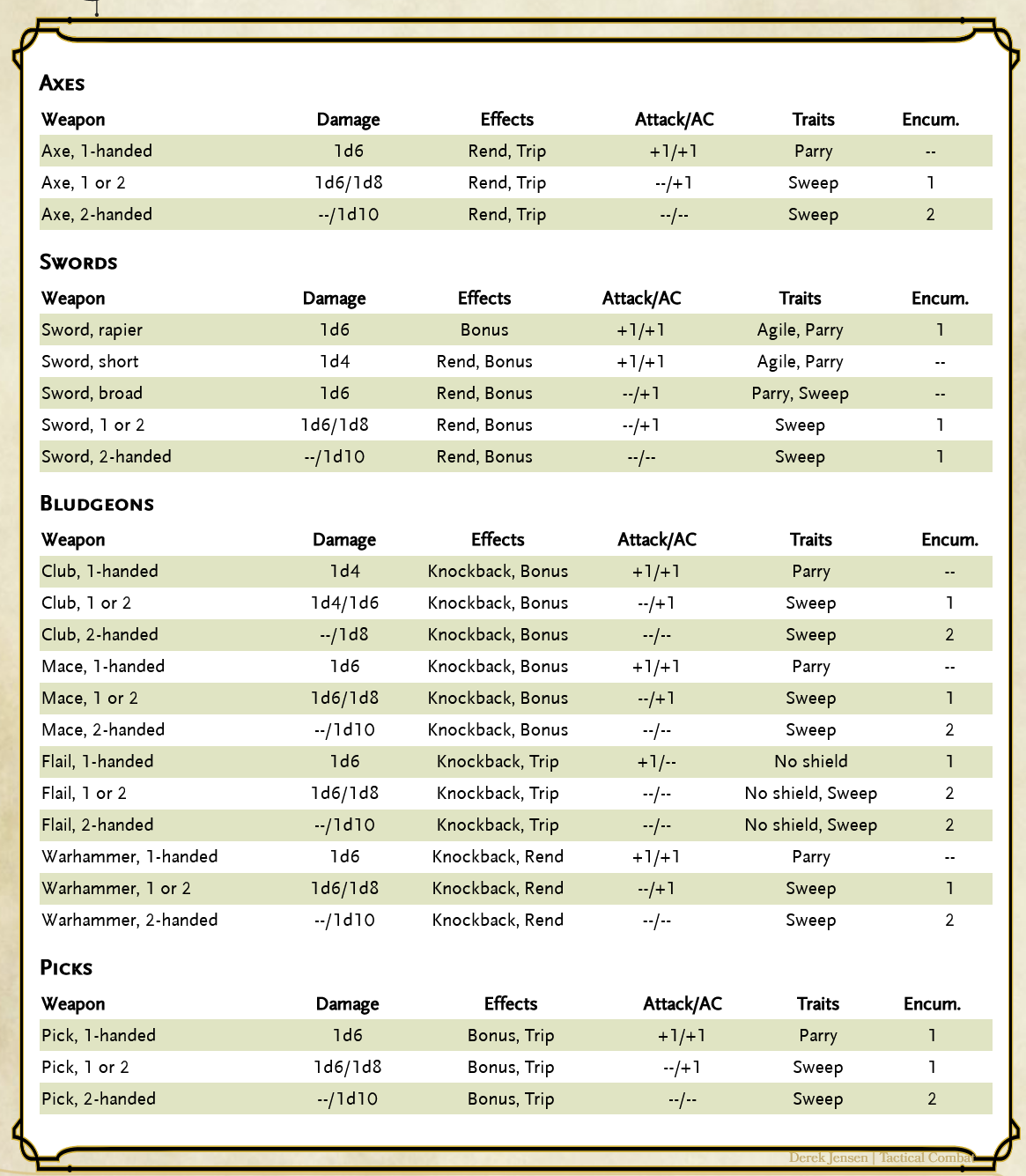
If you roll an 18+ on a melee attack, you can choose a weapon effect from one that applies to your weapon (see Combat).
- Trip: Trip (free attack) or disarm the opponent (DEX check), if reasonable (per GM).
- Rend: Rend the opponent’s armor or hide, causing -2 AC.
- Bonus: +2 damage.
- Knockback: Knock back an opponent a distance.
- Rapier: Parry an opponent’s weapon (per GM) to take no damage from one attack.
Combat
Combat rounds are 15 seconds long. You can ready an action to use before initiative is rolled.
Initiative
Resolve any readied actions first. These are simultaneous.
If no character seizes the initiative, each side rolls 1d20. Give a bonus to one side if it has significantly more characters, are of significantly higher level, or are more prepared. Deal with a character chosen by the winning side, then a character chosen by the other side, alternating until all characters have gone thru all their available actions.
You may group some monsters together (three goblin slingmen all going at once, for example), and may decide when extra characters and non-combatants act.
Initiative is not rolled each round. However, if a spellcaster casts an area-effect spell or if there is some other disruption, you may decide it causes the combatants to pause—ducking for cover or shading their eyes—and call for initiative again.
Actions
You can make a melee attack and perform a maneuver or perform two maneuvers. These are common maneuvers:
- close for melee up to half your “rush” movement rate (45 feet)
- charge half your “run” movement rate (varies by race) in a straight line
- shoot an arrow (1d4/1d6) or light crossbow (1d4, latchet/hand draw)
- throw a dagger
- perform a hand-to-hand maneuver, if your melee attack hit
- load a medium crossbow (1d6, crow’s-foot lever)
- shoot a loaded crossbow
- sacrifice your shield to block a hit (see Shield Sacrifice, below)
- cast a cantrip
- something else (pull a lever, drink a potion you have handy, etc.)
Each of these costs two maneuvers. You must perform both in the same round.
- move your “rush” movement rate (90 feet)
- move your “run” or “sprint” movement rate (varies by race) in a straight line, as chasing or fleeing
- cast a spell
It takes 2 rounds to load a heavy crossbow (1d8), a weapon of war that uses a windlass and is not effective for adventuring.
Any character can add +2 to their own armor class each round of combat that they move backwards 5 feet. This stacks with your tactical bonus for your own armor class only.
If you charge (as a maneuver), you take the initiative unless the opponent has reach (weapon with the reach trait or long limbs). You also get advantage on your first melee attack and damage, if it hits.
Shield Sacrifice
If you use a shield, you can choose to sacrifice your shield to block all damage from one attack after learning how much damage it would be. Your shield is damaged beyond repair (altho a magic shield merely breaks a strap and so can be repaired by an armorer).
Hand-to-Hand maneuvers
Sometimes, your melee attack roll allows you perform a hand-to-hand combat maneuver, if your opponent is a humanoid the same size or one size smaller. If you hit with the values below as your natural roll and your opponent does not hit in this round, you can perform that maneuver or any maneuver of a lesser roll. For example, if you hit your opponent with a natural 15 plus your modifiers, you can perform a grapple or tackle in addition to your weapon damage. If your roll plus modifiers doesn’t hit or if your opponent also hits you, you can’t perform a maneuver.
- A distance means a distance equal to your height. (5-6 feet for human, but 10 feet for ogre)
- You can’t fight most non-humanoids with these techniques.
1: Complete Miss: This is always a complete miss, and—for ranged weapons—the arrow, bolt, dagger, etc. is lost or broken; mark it off your inventory.
15+: Tackle/Shieldbash: If you don’t use a shield, you can tackle your opponent, pushing him or her back 5 feet; both go down. You now have the opponent in a grapple on the ground. If you use a shield, can instead do 1d3 damage with it.
16+: Grapple: You can take hold of your opponent in a standing grapple. The next round, the opponent must make an opposed strength check to break the hold. Otherwise, the opponent can’t take an action, and you can cause 1d6 hp damage plus strength bonus or (if you’re standing and not on the ground as a result of a tackle) move the opponent a distance in any direction. Biting creatures get an automatic hit with the bite instead of the hold damage.
17+: Shove: You can shove or kick your opponent back a distance away from you. A smaller opponent is also knocked prone.
18+: Weapon Effect: You can use an effect based on your weapon type (see Equipment).
19+: Knockdown: You can knock your opponent back a distance away from you and prone. A smaller opponent also takes an additional 1d4 hp damage. In either case, you can get a free attack by advancing.
20: Critical Hit: Maximum damage plus normal damage. This is a feature is available only to creatures of 2 HD or more.
Great Blow
If you kill a creature with an attack that does 10 or more points of damage, you chop off its head, crush its skull or spine, or pierce it thru the heart or throat, etc., as appropriate for the weapon.
Injury & Death
Bloodied: At half hit points, you are bloodied (noticeably injured); monsters must check morale when bloodied.
Injured: When reduced to 5 hp or less, you are injured and get disadvantage on attack rolls and physical skill and ability checks. Roll 1d6 for the location on the table below.
Seriously Injured: When reduced to zero hp, you are seriously injured and could die. Roll for hit location. Save vs death.
- On a success, you’re stable at zero hp and can crawl if conscious.
- On a failure, fall unconscious until allies aid you, then roll again with a penalty of -1 per round until you got aid. (Note that divine favor works here.)
- If you succeed, you are stable at zero hp but cannot crawl.
- If you fail, you’ve died from your wounds.
When seriously injured in combat or a fall, roll 1d6 for the location. If you survive, you’ll have a scar there. If you are conscious, you can crawl. If you take more damage while at zero hp, you die immediately.
| 1d6 | Legs |
|---|---|
| 1 | Leg/hind leg (or tail, if no legs) |
| 2 | Left arm/foreleg (or torso, if no legs) |
| 3 | Right arm/foreleg (or torso, if no legs) |
| 4-5 | Torso (or head, if no legs) |
| 6 | Head |
Monsters at Zero Hit Points
Monsters of 5th level and above can avoid the damage of one attack that would reduce it to zero hit points by instead taking a major scar or suffering the loss of a limb (including a tentacle). Except for undead, such creatures will almost always try to flee.
Falling Damage
While you can purposely jump as much as 5 feet without damage, if you fall and land on a hard surface, save vs half the height in feet (so, 10 for a 20-foot fall). If you succeed, take 1d4 hp damage per 5 feet.
If you fail, you’re reduced to zero hp by a serious injury (broken bone). See Seriously Injured, above for effects of being reduced to zero hp.
If you tumble down a steep slope, you take 1d4 hp per 10 feet and don’t need to make a save.
Resting and Healing
If you have been seriously injured, even with full magical healing, you will retain the -2 “injured” penalty until you get a good night’s rest.
Otherwise, you can bind wounds and sleep at least 6 hours to regain all once-a-day powers and 2 hp per level (or, if sleeping in heavy armor or interrupted by attack, 1 hp/lvl).
Magic Items
Each character can attune to a number of rare magic items equal to two plus his or her charisma bonus.
Searches
I would use my own search rules.


Leave a comment