

Quite a while ago, I wrote about how people are puzzles too. You can create a lot interest among your players if they have to figure out how to get what they want from NPCs without resorting to violence. They can resort to violence with monsters, of course, but you can make them more of an intellectual and role-playing challenge than a tactical and dice-rolling challenge.
Certain monsters have known distinctions—abilities, resistances, immunities, and vulnerabilities—a troll’s ability to regenerate, for example, and its vulnerability to fire or acid. Not only can you change that (a banded troll versus a crested troll or whatever), but you can expand it to other creatures whose distinctions won’t be well known.
These are great opportunities for rangers and druids and even fighters and paladins to know something the egghead spellcasters don’t. I give monster lore skill to martials and nature lore to rangers and druids, and that gives them some chance to already know something about a creature (even if it’s just identifying it). Then they can go to locals and sages and witches and local druids and try to learn more. The NPCs may know a little or a lot, but it should always be enough for the heroes to put up a good fight.
It’s especially great if the heroes can learn about the creature as they go after it. Maybe they find a clue in its droppings or the remainders of a meal or a trail of destruction or something it avoided. Did it eat everything in the merchant’s cart except the munkleberries? Maybe it’s vulnerable to people who have recently eaten munkleberries. Did it avoid a cart that contained a mirror even tho it also contained its favorite food? This sort of thing can be part of an NPC eyewitness’ story or something the heroes discover for themselves.
Monsters
The best sorts of creatures to use this way are those that already have folklore clinging to them, so they have an air of mystery.
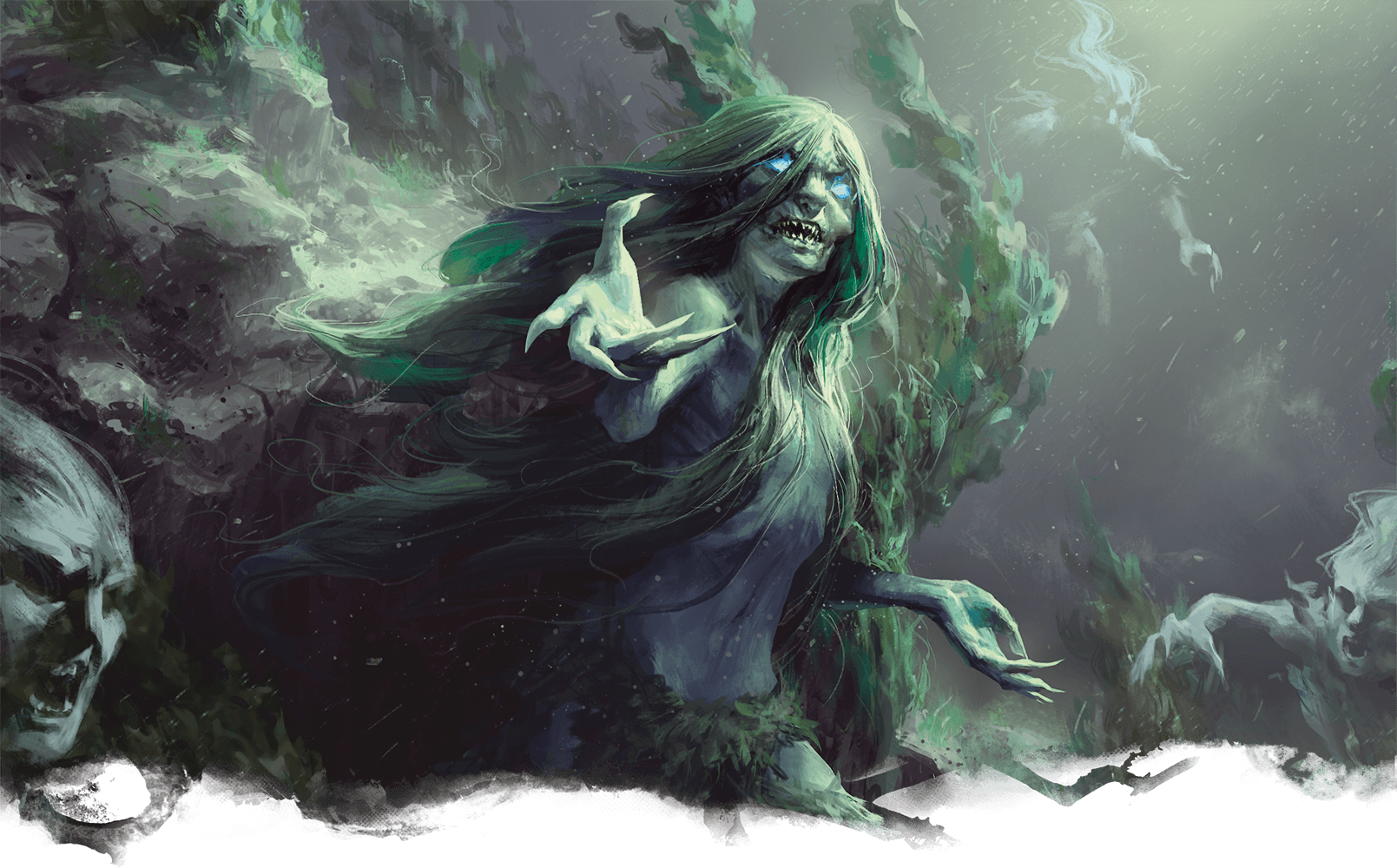
- Hag, which should be creepy and powerful.
- Rakshasa, which should be unsettling to encounter.
- Medusa, which should be clever and terrifying.
- Cyclops, which should differ from giants.
- Troll, which should be disgusting.
- Cockatrice, which should be bizarre and unsettling.
- Mummy lord, which should be frightening.
- Sphinx, which should be crafty and mysterious.
- Lich, which should be creepy.
- Basilisk, which should be ominous and terrifying.
- Umber hulk, which should be bizarre and confusing.
- Corrupted beasts, such as a cursed giant boar.
Maybe this is something that you reserve not merely for boss monsters but for eldritch creatures that have some special quality in common. They’re a “Markovan troll” and a “Markovan ogre” or whatever, because they were part of the experiments of the mad lich Markovus. Or they came from the eldritch pit of Markov, which corrupts all creatures.
Distinctions
Distinctions are the various special abilities, resistances, immunities, and vulnerabilities of monsters.
Special Abilities
- Breath Weapon: Has a breath weapon (fire/acid/cold/lightning/poison).
- Charge: Double damage if able to get a running start.
- Charm: Has an ability to charm that turns some foes into defenders.
- Confusion: Has a gaze that causes confusion.
- Constriction: Target must make STR check or be grappled, taking 1d4 damage per round.
- Demolish: Can charge thru, burrow thru, or otherwise destroy walls, stone, earth, etc.
- Fear: Exudes a gas that causes fear.
- Flying: Fly-by attacks. Melee opponent must make DEX check to be able to attack.
- Fury: When reduced to 0 HP, makes a WIS check. On success, regains 1d6 HP and becomes enraged.
- Grapple: Can forego attack to grapple a target (DEX check to avoid). Take 1d4 STR damage each round; STR save to escape.
- Invisibility: Invisible until it attacks.
- Petrification: Gaze or touch turns an opponent to stone.
- Regeneration: Regenerates hit points each round.
- Shape-shifter: Can change form into a human, animal, inanimate object, etc.
- Stealthy: Is particularly stealthy and so normally gets surprise.
- Swallow: Can unhinge its jaw and/or widen its mouth unnaturally to swallow a man-sized creature (or perhaps only a small creature) whole.
- Swarm: Small and numerous enough to swarm, doing extra damage and giving resistance to piercing attacks
- Terrify: Opponent must make WIS check or become panic (run away for 1 minute).
- Trample: Extra damage if able to trample.
- Venom: Successful bite (or claw) makes opponent save vs poison or take damage.
- Drag Away: Two successful attacks in the round (such as both claws or claw/bite) and it drags the opponent into its lair/underground.
- Snatch: hit on opponent smaller by two sizes allows it to snatch the opponent up and control it, including throwing it for 3d4 damage.
Boss Monster Actions
In my post on reactions for OSR, I listed these boss action ideas. Give these only to particularly powerful creatures who are the climax of the adventure or section of a dungeon.
- Summoning Rings: The boss begins magically summoning minions, so 1d3+1 summoning rings appear. They will dissipate when a living creature occupies them; this can be the summoned creature or a hero, if a hero moves onto one (or throws an opponent onto one or something). Any ring that remains unoccupied at the end of the round generates a summoned creature to fight for the boss. (The first or second time you use this, you might demonstrate it by having a boss’ minion accidentally cross over a ring and dissipate it.)
- Target Switching: The boss targets the last hero to attack it with a melee or ranged attack (magical or not). If another hero attacks it before its next attack or the end of the round (whichever comes first), the boss changes its target to the new hero.
- Hazardous Presence: Being within 10 feet of the boss for more than one round causes damage, induces fear, or has some other effect. So heroes need to hit and run (remember that you can split your move in this system), but remember that the boss can follow them.
- Confusing Aura: Creatures within a 40-foot cone of the boss’s front must save or become confused. Even those who save are muddled enough to require an extra action to cast a spell. The boss moves and turns around frequently, changing where this cone is.
- Uncontrolled Rage: When bloodied, the boss becomes enraged and ignores non-magical attacks but makes only basic (physical) attacks, but at double damage. The rage ends when the boss takes any physical (magical) damage.
- Arcane Deflection: The boss can spend a 4th-level spell to deflect a magical effect aimed at it to another creature other than the caster.
- Charm Touch: If the boss physically hits for damage, serum in the wound causes the victim to save vs charm or obey the boss as a charm spell. It makes a new save each round.
- Parasite Infection: If the boss (a parasite controlling a host body) is reduced to 10 hp, it will attempt to seize a healthy opponent and transfer itself from mouth to mouth. The victim must make a contested STR check to get free. If the transfer is successful, the old host takes 10 hp damage, and the new victim must make a CON check to expel it or the boss takes control of the victim. Remove with “Remove Curse” or similar magic.
- Witchery: If the boss reduces an opponent to zero hit points with a serious injury, it injects a serum in the wound that raises the victim to 20 hp as healing magic. It automatically obeys the boss as a charm spell but gets a save vs charm each hour.
- Blind Hunter: The boss has very poor vision and a sense of smell roughly equal to a human’s. It hunts in darkness with its hearing. Characters who don’t move or who move silently are effectively undetectable by the boss. If it detects a character, it pounces up to 30 feet for 3d6 damage. The victim must make an opposed STR check or be held (for a bear hug, bite, etc.)
- Self-Destruct: When brought down to zero hit points, instead of collapsing, the boss (a construct or weird monstrosity) becomes enraged and self-destructive, with a clear indication (bulging, reddening, steaming, shooting off limbs for damage, etc.) that it’s going to explode the next round. Altho still mobile and able to fight, it then does explode for 4d6 damage to all within 20 feet.
- Guardians: The boss has 1d3+2 guardians (constructs, beasts, etc.) that always move to block physical attacks on the boss. The boss can deflect any magical attack to a guardian instead. The guardians can absorb lightning attacks and later throw them at targets of the boss’s choice as if it originated from guardian. Each guardian also gives the boss +2 to all saving throws.
Resistances & Immunities
- Is surrounded by an anti-magic or wild magic aura.
- Magic of all kinds/arcane magic only/divine magic only.
- Non-magical weapons.
- Slashing/bludgeoning/piercing weapons.
- All weapons that haven’t been blessed by a priest since the last full moon.
- Attacks that use water/fire/acid/cold/lightning/poison/necrotic damage.
- Blinding/deafening/restraint/fear.
- Attacks by men/women/anyone whose name it knows.
- Attacks by any creature with a name whose name it doesn’t know.
- Attacks that change its shape or control its mind.
- Invisibility, illusions, and other alterations of appearance (it has truesight or blindsight).
Vulnerabilities
The creature might…
- Lose one of its resistances or immunities under a condition below.
- Lose one of its abilities under a condition below.
- Become disoriented under a condition below.
- Take double damage under a condition below.
- Be strongly distracted by/attracted to… (1d6: 1=fresh meat; 2=decaying meat; 3=shiny objects; 4=brains; 5=its mating call; 6=a thing it’s immune to).
- Be strongly repulsed by/afraid of… (1d6: 1=confidently presented holy symbol; 2=running water; 3=fire; 4=fungus; 5=silver; 6=mice).
Conditions for the above:
- Under a full moon.
- In water/running water.
- In sunlight/darkness.
- In silence.
- If it’s addressed by its true name.
- If it’s reminded of its life before it became corrupted.
- When confronted with a secret from its past.
- Hit by a weapon made of silver alley/magic alloy/cold-wrought iron.
- Hit by a cleric/druid/paladin/elf/halfling.
- Hit with a water/fire/acid/cold/poison attack.
- If you have recently chewed… (1d6: 1=aggle root; 2=radish; 3=willow bark; 4=frog’s legs; 5=dried pig’s ear; 6=troll skin cracklings).
- A certain body part is damaged (antenna, whiskers, horns, etc.)
- If struck by a weapon… (1d6: 1=of a betrayer; 2=of a murderer; 3=sharpened with water from nymph’s pool; 4=sharpened with the blood of an innocent; 5=blessed by a priest; 6=consecrated by a druid).
Leave a Reply