

I’ve written a lot about travel and hex crawls:
- Using rumors to drive your campaign
- Using hex or point crawls as the basis of your campaign
- Easy rules for hex travel
- What types of things might be in a given type of hex
- What specific major thing might be in a given type of hex
- What specific minor thing might be in a given type of hex
But you might still wonder how to make those things come together. There are two basic ways….
The 6-mile Hex Technique
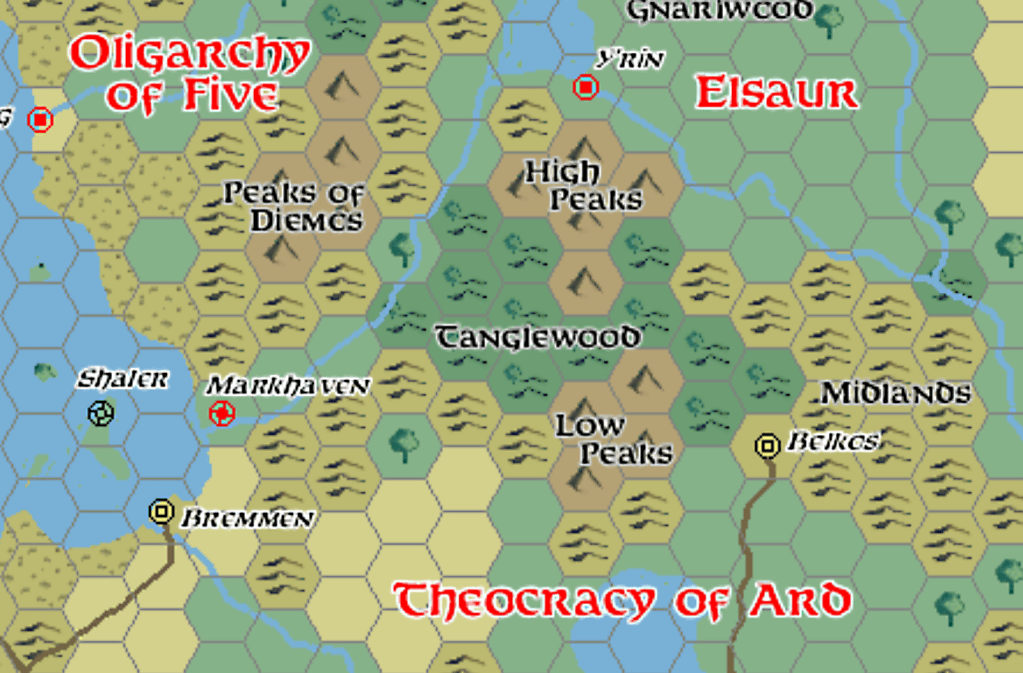
A popular old-style hex-crawl technique uses a medium-scale map of a region of your realm, which is best (I think) with 6-mile hexes. This provides good separation between points of interest, and represents a whole, half, or third of a day’s travel, depending on the terrain.

From the middle of a 6-mile hex, on flat ground, you can see to the horizon 3 miles away; that’s basically the whole hex. Therefore, when the heroes enter a hex that’s not a forest or swamp, any major point of interest should be pretty obvious–roads lead to towns, ruins usually sit on hills, etc. From a high hill or a tower, you can see another hex or two further. There should be a major point of interest every 4 or 5 hexes.
Of course, where there are trees, you’re limited to seeing to the treeline, except for mountains, which could be 10 or more hexes away (so, basically, practically any mountains on your map–unless your map is a huge one).
Minor points of interest should generally be known by local shepherds, altho they may be afraid of it or otherwise never visited it. There should be a minor point of interest in between most major points of interest.
| 1d20 | Contents of a 6-mile Hex |
|---|---|
| 1-13 | Ordinary terrain variations |
| 14-17 | Minor point of interest (interesting location illustrating the terrain, culture, or central tension) |
| 18-20 | Major point of interest (city or peril ripe for adventure) |
Create a master list of points of interest (and add more at any time). It’s not practical to put all your points of interest on your map. Instead, label your map with place names (Lovan Mountains, Galbrath Swamp…) and salt it with a few major points of interest (city of Tinarbin, ruins of Barnith Castle, Crag of Peril…).
Once the heroes get the location of a new point of interest, then you should add it to the map. Index it on a copy with its number from your master list.
Don’t forget about travel encounters. When the heroes encounter people who have information, they should have a bit of information about the hexes they came thru.
The 1-mile Hex Technique
My preferred technique is to create a large-scale map of a realm with 18-mile hexes.* Add geographical labels as before and major points of interest–but just the biggest cities and best-known perils. (Everyone knows where the earthquake-ruined city of Voril lies and that Smoke Top is home to Marbralga the crested dragon.)
I’ve since switched to 9-mile hexes for more flexibility when rushing or using horses.

Then create a few 1-mile hex maps, each centered on a city (not necessarily a major one). These should be at least 18 hexes across, so it represents the area around the city it’s centered on.
At this scale, knowledgeable people in the area (innkeepers, sages, officials, and merchants) will have heard about nearly everything on the map. There can be a handful of adventures on a 1-mile hex map (goblins here, orcs there, a mysterious ruins in the hills…), but the heroes might have their first three adventures on one map then travel across the big map to another city, where you’ll have another 1-mile hex map waiting with a few more adventures.
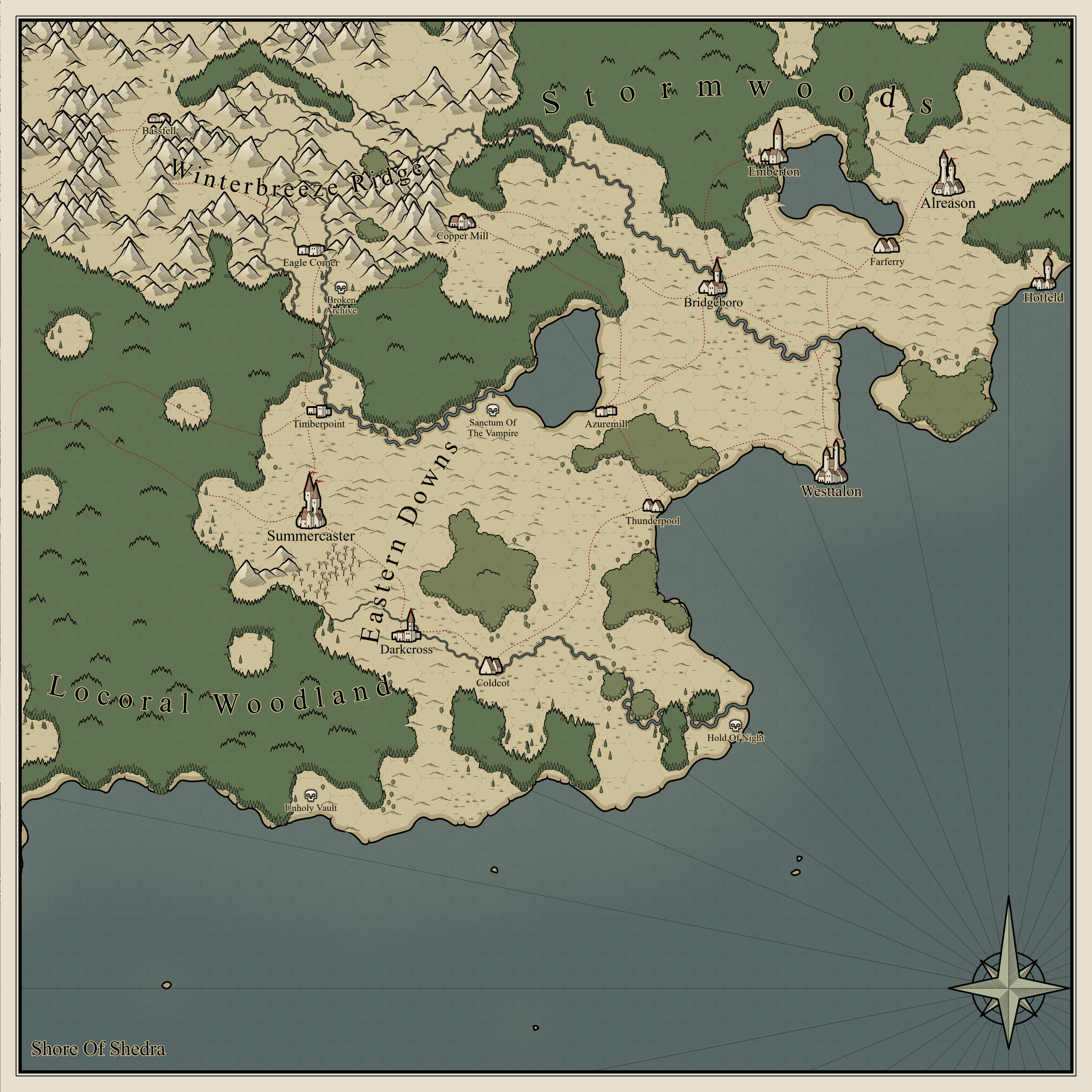
As they cross this small-scale map, roll for each hex just to see if they happen across a minor point of interest, since the major points of interest (cities, towns, and perils) are already mapped. Use a dice timer of d12, d8, d4, and d1, and on a 1 there’s a minor point of interest (an interesting location illustrating the terrain, culture, or central tension). Anything else is ordinary terrain variations.
You should create multiple rumors for each peril, so the players can choose where they want to go. They might only hear about one or two at first (especially if they traveled here specifically to follow up on a rumor they heard elsewhere about a particular peril). Then after that adventure, they hear about another peril or two they might knock out while they’re in the area. Then they hear about some more distant treasure, and they’re off traveling across the big map again.
Indexing Points of Interest
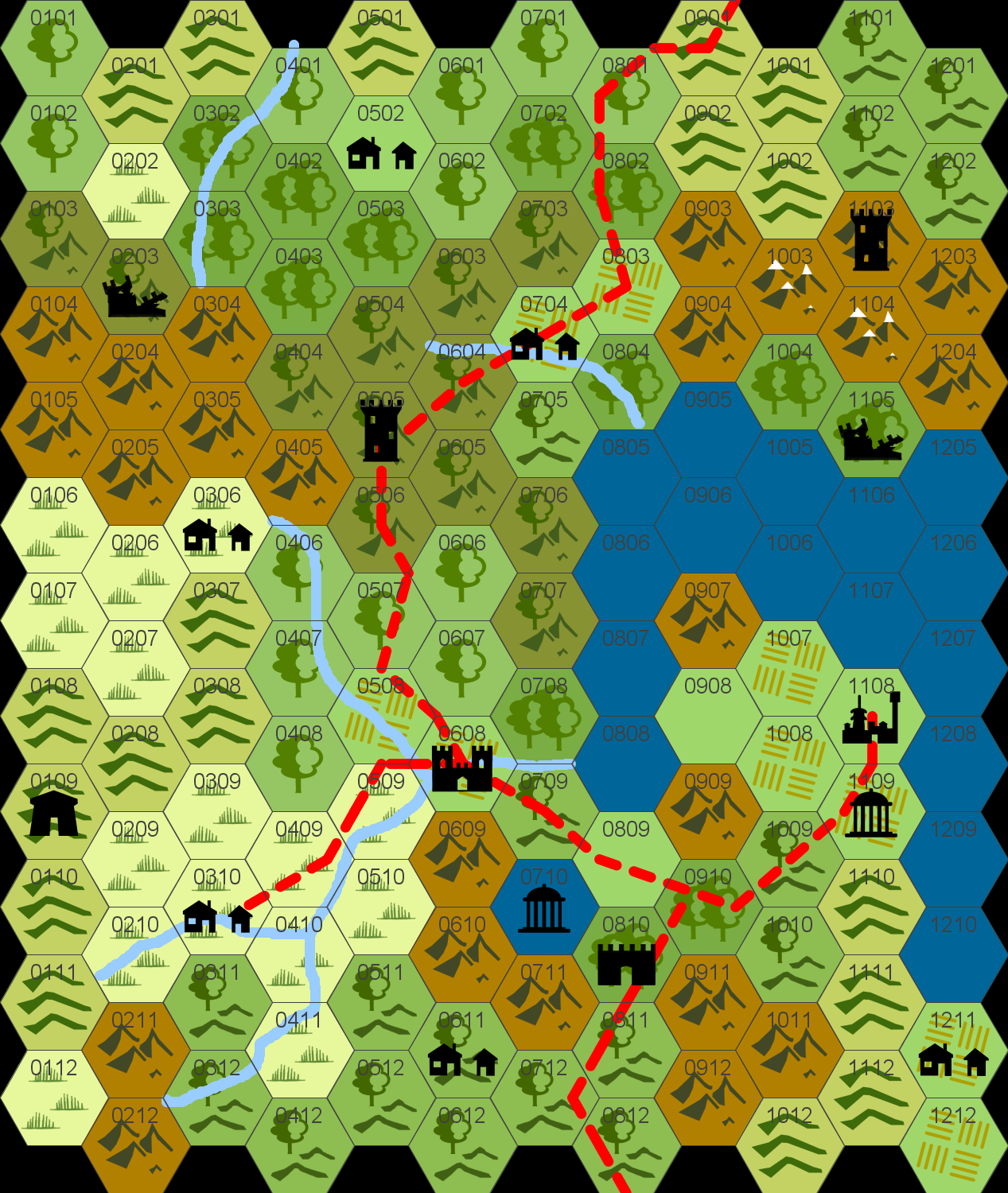
When you’ve decided on what exactly is the point of interest in a given hex, you can write its index number from the list in that hex and on a working list of all the places the heroes have visited (both of which become neat ways of looking back on your adventures). Keep your master map clean, of course, and just add the index numbers to a copy. You can show both to the players on the assumption that they would make such a map on their own anyway; you’re playing a fantasy adventure game, not a cartography game.
Some systems suggest that every hex be numbered, and then you keep a list of what’s in each one. But then if you want to find where you put the Maze of Balkar, that leads to you looking down a long list for “Maze of Balkar” and finding “0610” beside it and then trying to find hex 0610 on your map full of numbers obscured by terrain symbols.
With my way, you can just find “11 — Maze of Balkar” on your places-visited list (or your master list), then look on your map copy for the hex you wrote “11” in, which is easy, because you’ve only put a number in a few hexes. This goes the other way as well. If you want to know what “11” on your map copy was, just check your master list for entry 11 and see it’s “Maze of Balkar”.
You might plot the route the heroes took between places visited so you don’t accidentally place a new major point of interest in a hex they already passed thru. But generally, you should put new points of interest away from their previous adventures anyway, so they continue traveling and exploring.

On this 6-mile hex map, you see many sessions’ worth of exploration and adventure on a lightened copy of the master map, each location about a days’ travel from each other. Some of these are major points of interest where the heroes spent a whole adventure, while others are just minor points of interest they encountered in their travels. After each adventure, the heroes would go to their current home base city nearby.
Places Visited List Example
- 2 — Caves of Peril
- 22 — Tower of Arbrin
- 23 — Troll camp with remains of Sir Conolir
- 21 — Ever-fruiting Tree of the Elves
- 27 — Lost Well of Goulart
- 11 — Maze of Balkar
- 14 — City of Numelor
- 45 — Camp of Hongus, chieftain of centaurs
- 43 — City of Glass
Master List Example
This is basically your list of ideas for adventures. You’ll add them to the map as your adventures progress. If you want the heroes to do a bit of traveling, give them a reason to go to the Hall of Dark Dwarves and place it three or four hexes away from their current location. Note that inhabited cities and castles and some well-known ruins and perils are labeled directly on the map. Any inhabited 6-mile hex without a city or castle is assumed to have 1d6+10 manors and one town (1-4) or coaching inn (5-6). Every inhabited 36-mile hex should have a city surrounded by 1d6 towns with numerous manors in between.
- Lair of the Short-tailed Goblins
- Caves of Peril
- Towers of Bilbart and Lowe
- Ruined Temple coaching Inn
- Dopian Sinkhole
- Endless Fair of the Farmorian Trade Caravan
- Water Witch’s hut
- Tower of Non
- Fortress ruins dungeon
- Broken Tower
- Maze of Balkar
- Waterfall caverns
- Coverstone Crag
- Hall of the Dark Dwarves
- Ruins of Falgon (goblins)
- Ruins of Horsebridge (bandits)
- Ruins of Brewmasters (hobgoblins)
- Ruins of Bornleytown (orcs)
- Ruins of Castle Gilper (giant)
- Ruins of Castle Vestern (gnolls)
- Ever-fruiting Tree of the Elves
- Tower of Arbrin
- Troll camp with remains of Sir Conolir
- etc.
 zarban.com
Leave a comment